Good times and bum times, I’ve seen ’em all…
And, my dear, I’m still here.
Plush velvet sometimes;
Sometimes just pretzels and beer, but I’m here.
I’ve run the gamut, A to Z.
Three cheers and dammit, C’est la vie!
I got through all of last year, and I’m here.
Lord knows, at least I was there, and I’m here.
Look who’s here: I’m still here!
Yes, I know. I should not have been surprised. But I was stunned when someone learned one fact about me, and then, relying solely on stereotypes, proceeded to imagine a great many other things about me… most of which were untrue.
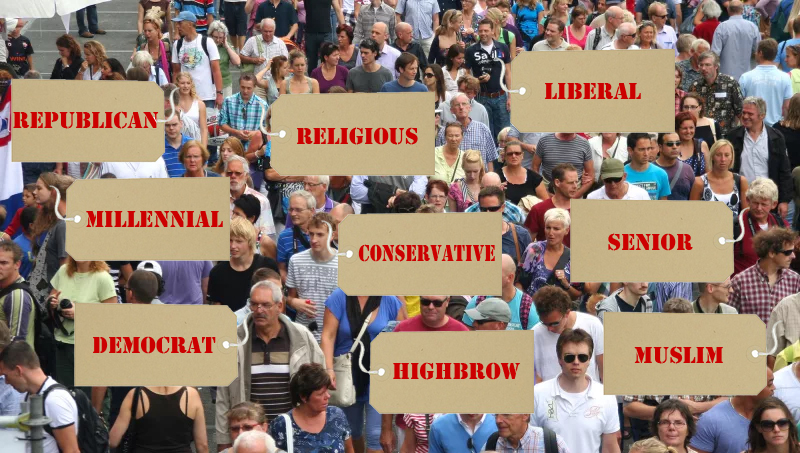
It happens with alarming frequency. We label a person. The human tendency is for our imaginations to fill in the blanks… often with that which we fear. We make assumptions about a person’s character, personality and beliefs, based on this label and what it is popularly believed to represent. Those assumptions may or may not be correct… but most people never bother to find out.
Often, the function of a label is establish division. It is a way of individuating oneself: establishing your own identity by highlighting how you are different from others.
Owning your own identity is a good thing. The problem comes when you try to shore up your identity, not just by having pride in yourself, but by denigrating those who differ from you… as if to say, “I’m good, and you’re not.”
This is not a new problem. People complain about it constantly. I hear many people bemoan the divisions in our country. Political differences, religious differences, cultural differences. Yet I hear very few go beyond talking, and actually try to do anything about it. For most people, bridging the gap and healing divisions seems to be about vanquishing the “other side.”
If we ever got honest enough to go out in the streets and uncover our common grief, we would discover that we are all grieving over the same things. –Miguel Unamuno
But here’s a secret. Believe it or not, it is possible to own your identity, to feel strong and confident about who you are and what you believe… without demonizing those who believe something else. Yes, as amazing as it might seem, you can treat someone with courtesy and respect even if you think that their values and beliefs are dead wrong. You can hold on to your own values, without compromising your beliefs, and still be friends with people whose values and beliefs are the opposite of yours.
Bridging that gap is not easy; it requires listening with an open mind. Instead of making assumptions about what someone believes, why not actually ask them? Why not find out what they believe? You might be surprised. You might even discover that you have more in common than you think.
This seems to be a difficult thing to do. The person who labeled me had no interest whatever in my beliefs. Their only interest was to say, in so many words, “You are not like me. I reject you.”
Convictions are more dangerous enemies of truth than lies. –Friedrich Nietzsche
As I’ve pointed out before, scientists have demonstrated that we are genetically more invested in winning arguments than in thinking clearly. Confronting this person would have been useless because they were entrenched, and unable to hear or see any reality other than the one they had created for themselves. So I remained silent. But there are a few things I would have liked to say:
You have NO clue what I believe.
I do not fit into most standard label categories. It’s almost impossible to label me as liberal or conservative, Democrat or Republican, Christian or agnostic, or any kind of class distinction. But somehow, you decided that I fit neatly into some category, and that, as a result, you know everything there is to know about me.
You are totally wrong.
Not only do you have no clue what I believe, you THINK that you DO know. Because of your mistaken certainty, your mind is completely incapable of discerning the actual truth. You have no curiosity at all, no desire to find out what is real. And that lack of curiosity has made you blind.
I know who I am. I know that your assumptions about me are wrong, mere fantasies concocted by your imagination. They don’t affect me. But they sadden me.
I feel sad for you, because you cannot see. I feel sad for our world, because this blindness is widespread and causes rifts that continue to deepen, spreading hostility, fear and pain to everyone.
But I’m not giving up on you. I’m holding out hope that one day you will find the strength to challenge your fears, and crack the closed door of your mind just enough to let in a little light. I’m holding out hope that in the end, love will be stronger than fear.
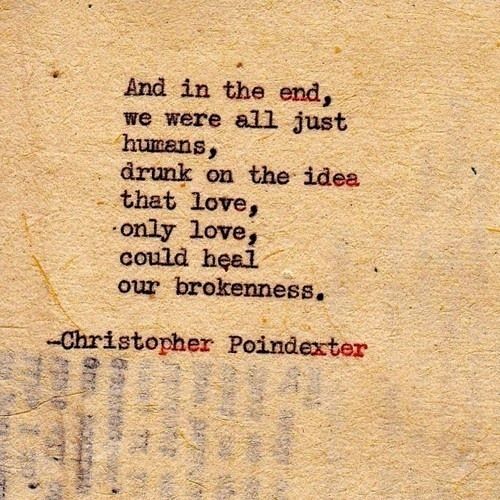
And in the end, we were all just humans, drunk on the idea that love, only love, could heal our brokenness. –Christopher Poindexter
It was a tagline on House, M.D., the television show in which a doctor had to navigate a web of illusions and untruths to diagnose mysterious maladies. Dr. House listened to what patients had to say, but he never trusted it until he proved it himself.
Scientific research has demonstrated that everybody lies. Part of the social contract that keeps society functioning includes a network of small lies, starting with “How are you?” and “Fine, thank you.” We have all agreed to suspend disbelief, to a certain extent, in the context of social niceties.
Additional research shows that everyone lies on the internet especially, and that the more anonymous the online setting, the more likely people are to lie. This is bad news for virtual worlds, which are basically anonymous. Apart from the element of fantasy, for instance making one’s avatar look different from one’s real-life self, the anonymity of the virtual world makes it easy for us to invent stories and conceal truth.
I think about this a lot when I perceive that I am being lied to. I rarely confront someone about it, nor do I let on that I realize they are lying. But I do think about it. Most of all, I wonder: Why? Why are they lying to me?
There can be a lot of answers to that question. Personally, I sometimes lie to preserve my privacy. When writing online profiles I usually say that I live in NYC. I don’t. I live near NYC, and I do spend time there, but I don’t live there. I don’t really want strangers to know where I live. I think that is a fairly smart lie and I doubt many would disagree.
“Privacy lies” like this happen when someone is pressuring you to reveal something about yourself that is actually none of their business. When someone lies to me, I wonder whether the person perceives me to be prying, and is trying to protect his or her privacy. In other words, is the lie basically a way of telling me to back off? I can understand that.
People also may lie to protect themselves from punishment. “Self-preservation lies” may happen when we have done something we weren’t supposed to do, or when we have not done something that we were supposed to do. If someone tells me a lie because they don’t want me to be angry at them, I can accept that. But I am still disappointed that I have been lied to. It indicates the presence of a basic rift in my relationship with that person, and it makes me sad that they do not trust me with the truth.
Then there is the “I didn’t want to hurt your feelings” lie. Sometimes this type of lie is actually compassionate, or at least benign, like when he assures her that she doesn’t look fat in those pants. But this type of lie can also be an attempt to cover up something that is extremely hurtful. It makes me anxious, wondering: what is this thing that would hurt my feelings? Just how hurtful is it?
Although I can forgive many lies, without knowing the reason why someone is lying to me, my imagination has to juggle all the possibilities. It’s exhausting. On one hand, I want to be compassionate if the person has good reason to protect their privacy. On the other hand, part of me wonders whether something hurtful is being concealed. And then I begin to wonder why the person does not trust me enough to be honest.
So, in the end, even benign lies leave me with inner turmoil, hurt feelings, sadness, disappointment and suspicion.
But since everybody lies, I suppose the burden falls on me to cope with it.
I have a dear friend who simply does not understand my affinity for BDSM. Despite countless in-depth conversations, in which I do my level best to explain it to him, he persists in his belief that submission is demeaning and that everyone really prefers freedom.
Believing himself to be an open-minded person, he has constructed an illusion in which he does support submission. He does this by re-defining, in his own mind at least, what submission is; or by inventing a complicated argument that submission is in fact dominance. By clinging to this dubious construct, he can appear to agree with me, while never actually changing his beliefs.
He doesn’t get it. He probably never will. And I must live with that.
The illusion works for him within the limits of a conversation about abstract thought, when his ideas are not put to the test. But inevitably, something concrete will happen that forces the abstraction to materialize into action. Then, his actions do not bear out his conciliatory words. The curtain is pulled aside, and his true beliefs are revealed. And the truth is that he just doesn’t get it. He probably never will. And I must live with that.
It pains me to be at odds with my dear friend over this important aspect of my life. I would love to share my joy with him, but I can’t, because he doesn’t believe in it. While painful, conflict in a relationship is not at all unusual. I think we all find ourselves, at some point, having a major difference of opinion within the context of a close relationship. When it happens, must we choose between winning the argument and preserving the relationship? Is it possible to prove your point without hurting the other person? Is it necessary to capitulate, to keep the friendship intact? Or must we avoid conflict at all costs, agreeing not to mention certain issues, or pretending that the conflict does not exist?
We are genetically more invested in winning arguments than in thinking clearly.
These questions become even more complicated when we consider the fact that humans are inherently irrational – even the ones who most adamantly claim to be rational. Scientists have demonstrated that we are genetically more invested in winning arguments than in thinking clearly. It has been proven countless times that facts usually do not change our minds. We – all of us – experience something called “confirmation bias,” a trait that is hard-wired into our genes. It means that we all tend to embrace information that supports our current beliefs and reject information that contradicts them.
Furthermore, we also have a trait called “cognitive immunization” which means that the stronger our beliefs, the less likely it is that facts will sway us… no matter how true the facts are. The person you are arguing with probably will not be swayed by logic, reason or facts that contradict his or her beliefs. In fact, it is more likely that he or she will just become more entrenched.
Given that this is true, when two people have conflicting beliefs, it seems to me that arguing is pointless.
Given the choice between proving my point, and preserving the health of a relationship, I choose the relationship. Every time.
Given the choice between proving my point, and preserving the relationship, I choose the relationship. Every time.
So, I must let go of my disappointment that my dear friend does not share my understanding of submission. My dear friend is very important to me, and I want him in my life. I find great joy in submission, but I do not wish to wreck a friendship by insisting on winning an argument.
I also suspect that if I chose to associate only with friends who agree with my beliefs about submission, that would be a form of confirmation bias. My friends have many shades of beliefs and opinions about submission and BDSM. It is quite a varied tapestry. Total unanimity on this or any point probably cannot be achieved. And a circle of friends who all think alike could be a little boring.
So, I will accept the presence of the conflict and learn to co-exist with that tension. I will stop trying to convince anyone of the truth of my beliefs. Living with conflict is not comfortable. But there are many, many other things about those relationships that make them totally worth the effort.
A news article I read today — the topic of which is not germane — reminded me of an observation.
I have observed that people who have everything often find it impossible to be content with what they have.
Conversely, it seems that those who have little are much more likely to feel and express gratitude for whatever they do receive.
An old proverb says, “The sated appetite spurns honey, but to a ravenous appetite even the bitter is sweet.”
Right now, for example, I am grateful simply to be on the internet so that I can write this blog. We take connectivity for granted… until we don’t have it.
Yes. I am a strong, intelligent, secure, capable, boringly normal woman who is in a D/s relationship. Get over it, already.
Do not for a moment imagine that I have low self-esteem. I own who I am, I am humble about my challenges (we all have some), and I am proud of my gifts, abilities and accomplishments.
Do not imagine that I cannot recognize spite and petty jealousy when I see it.
Do not call me a doormat. I am independent and self-sufficient and there is only -one- person who gets to tell me what to do.
Do not call me weak. My way of life requires a reserve of inner strength you only wish you had.
Do not call me passive. I made a carefully considered decision, of my own free will, with clarity of mind, heart and conscience. Our life is a mutual, consensual choice.
Do not call me a bimbo. I have exquisite taste and I don’t wander around dressed like a hooker. My sex life is as private as yours, and probably no kinkier.
And p.s. It’s none of your business anyway.
I have been given the gift of submission, the freedom to surrender, the grace to trust, the privilege to love.
If that bothers you, I’m not the one with the problem.
Eight years ago today, Master, you gave me your collar, and in that moment I knew infinite joy. I am yours permanently, to infinity and beyond! I love you Master 🙂
(The background photo: “infinity room” mirrored art installation by Yayoi Kusama 2009. The artist intended it to symbolize eternal life; to me it captures my unending happiness as yours, stretching from that day eight years ago, to infinity and beyond!)
In 2014, on the 1st Anniversary of the opening of Littlefield Grid, my remarks were about building. On the 2nd Anniversary, my subject was inspiration; last year, on the 3rd Anniversary, I spoke about family. Today, I have one thing to talk about: Gratitude.
Gratitude is not only a debt we owe, or something we do to make someone else feel good. Gratitude should be something we do for ourselves. Having an attitude of gratitude, opening your eyes to look at your life and realize just how good you’ve got it, makes YOU a happier person. When we leave off complaining, and instead live in the awareness of the gifts we have been given, it changes our perspective about everything.
We have it good here on Littlefield Grid. We all could take a moment to step back, take a look at our situation, and realize just how good we’ve got it here. While other grids have failed, Littlefield is solid. Other grids have gone out of business; Littlefield is strong. Other grids have had technical breakdowns; Littlefield is running smoothly.
That is because Littlefield has what no other grid has. We have Walter. It’s because of Walter’s outrageous generosity that we have superior technology. It’s because of Walter’s vision that we have a virtual world focused on community, not profit. It’s because of Walter’s fierce leadership that each of us has a virtual home here.
And that is why I will lead the chorus of thanks – not because you need it, Master, but because I need to be grateful.
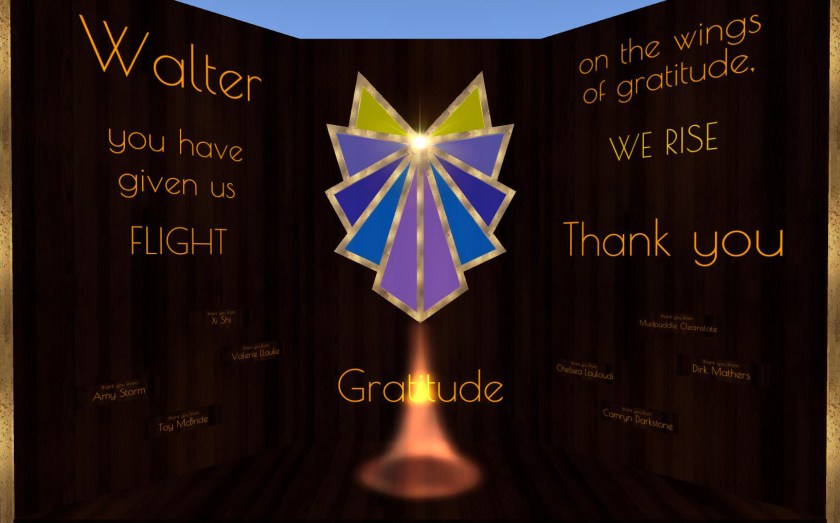
Master, when you gave me your collar, you promised to give me flight. And oh my, you have done that and then some. Buoyed up by your confidence and your love, I have soared. We all have.
In that spirit, I dedicate my exhibit for this year’s Anniversary as a monument of gratitude, to you, Walter, my Master and my love.
And I invite everyone whose lives have been touched by Walter’s kindness to join me in saying, “thank you.”
The name of my blog, “the space between,” is a reference to that belief. Everything in this life that means anything at all happens in the context of relationship, that “space between” people. And not just people: creatures, groups, nations, objects, ingredients, skills, elements, atomic particles, nature, physics, heavenly bodies, theories, emotions, opinions and ideas are what they are by virtue of their relationships. They may be relationships of love, friendship, opposition, attraction, admiration, reflection, negation, celebration or humiliation, but they are relationships nonetheless.
Nothing and no one exists in isolation. Everything and everyone is in relationship.
Our opinions and beliefs inhabit our relationships. Our convictions affect how we treat the people in our lives.
My most deeply-held convictions are expressed in a set of guiding principles by which I strive to live. Relationship is at the heart of those principles. I try to live a life filled with love and compassion. I seek and honor the goodness that is in every person as a reflection of divine love. I respect the dignity of every human being, whatever my relationship with them might be.
This is not some insipid, vacuous, feel-good idea. Love is a challenge. It is an urgent, important challenge. If I believe that the universe is built on relationships, what will I contribute to it? What world, what life, what relationships will I create? Will I love only those who love me? Can I love those who hate me? Can I find the presence of divine love in those who do harm? Can I respect the dignity of every human being, even those whose convictions arise from malice?
Yes, I can. It requires no small amount of mindfulness. But yes, I can see and honor the goodness in every human being, even when – like most of us – it is just one ingredient in a mix of hatred, pain, greed, fear, rage, and who knows what else. Human beings are messy. But there is always goodness in there. There is always something in them to love. I make the conscious choice to find it, honor it, respect it, and keep my attention on that above all else.
I do not turn a blind eye to hatred, deceit and malice. I do what I need to do to protect myself and those I love, and to serve justice. But whether or not I agree with someone’s ideology has little or nothing to do with my love for them. My loved ones represent a very broad spectrum of beliefs, opinions, and convictions. To quote Kent Keith and Mother Teresa: we are all unreasonable, illogical, and self-centered. I love anyway. I hope my loved ones love me anyway, too.
With maturity, one learns not to reduce humanity to white hats and black hats. One learns to tolerate ambivalence. I do love, and will continue to love, people who agree with me and people who disagree with me. I will consciously choose to respect the dignity of every human being, regardless of their beliefs and opinions. I will seek and honor goodness in all. I will love those who are given to me to love. I will strive to live a life of compassion and kindness, and nurture relationships into which I will pour every ounce of love I have to give.
Only in this way will I be the person I want to be.







 skills, elements, atomic particles, nature, physics, heavenly bodies, theories, emotions, opinions and ideas are what they are by virtue of their relationships. They may be relationships of love, friendship, opposition, attraction, admiration, reflection, negation, celebration or humiliation, but they are relationships nonetheless.
 the space between