Law of Drama

Law of Drama

We, all of us, are a messy mix of virtue and vice. But virtual worlds may lead us to see people through black or white filters. Instead of character flaws, we see demons. Every human being has some goodness inside them. Somewhere. But in the virtual world, we become convinced that we are utterly just, and the other side is mired in evil (or at least incompetence). We do not see our opponents as they are: flawed humans, as imperfect as we are ourselves.

There certainly are people and situations that deserve righteous anger: those who hurt for the sport of it; deceivers and exploiters; and those who engage in destructive behavior and thoughtless self-indulgence that causes harm.

But it seems to me that too many people are addicted to the primitive thrill of drama. They seem to hunger for the battle-lust of explosive anger, or the conspicuous display of woundedness from having been wronged. I won’t deny it: both the anger and the woundedness can feel very satisfying–especially because it seems so clean, when we can’t see the effect of our words in the facial expressions of our target. When we see them only in black and white. When we do not see them as whole, imperfect people.

Speaking for myself, drama bores me. It also makes me a little nauseous. It feeds on emotional energy and I have none to spare. Life is too short to waste one minute of it on such nonsense. My instinct is simply to ignore it, mentally flipping the channel.

I cannot stop anyone from trying to hurt me. I cannot control the behavior of others. I can only control my own. I try to do no harm. If someone claims to have been harmed by me, I try to embrace self-honesty and humility, always allowing for the possibility, however remote, that I might be wrong, and that I might learn something from my opponent. If I have done wrong, I swallow my pride and apologize.

I do believe in standing up for one’s strong convictions. I am not a member of the spineless school of can’t-we-all-just-get-along. If someone is harming me, I will do what is necessary to stop it—which usually means simply walking away. In most cases, fighting back stops nothing. It only prolongs it. If I choose to participate in their negativity, I give it power. If I turn my back on it, it has no power over me. I just turn away, without saying a word… and without giving any ground. I have no time or energy to waste on this crap.

Even when I have been hurt, I resist the temptation to demonize my opponents. As difficult as it might be to imagine, I do my best to assume that they are people of good will, trying their best, as I am, to live lives of integrity. They may be damaged (as I am) or lacking in communication skills (as I am). Their action may have been thoughtless, or misguided. If so, then striking back would solve nothing.

I do not engage in vengeance or payback. I treat everyone with compassion, whether they deserve it or not. When you do a small kindness for someone who hates you, they might spit in your face. But sometimes, a compassionate act, even a small one, is infinitely more powerful than an angry one.

And when I have been hurt, I resist the temptation to wallow in my woundedness. All that usually accomplishes is prolonging the pain and spreading it to innocent bystanders. If someone hurt me intentionally, broadcasting my pain would only encourage them. If the hurt was unintentional, the flaunting of bloodied bandages accomplishes nothing, and risks making me look ridiculous. I know how to cope with my feelings in an adult manner, and then let them go.

At all times, I listen, with an open heart, to the words of others, and to their fear, their wounds, their hopes and desires. I listen for the good in them. And I have never yet failed to find it.


This was written originally about political debate. I am republishing it by request in a shorter form.
Submission and Abuse

Are submissives more likely to end up in abusive relationships? Does being submissive imply acceptance of abuse? Is a submissive a victim?

These questions, inspired by my last post, have come to me in emails and IMs the last few days (come on, people, don’t be shy; post a comment!). I realize now that I did not elaborate on some elementary aspects of BDSM before that post, and those who are unfamiliar with the lifestyle might not understand them. So it probably would be responsible of me to back up, and reiterate the basics of BDSM safety.

One poll in 2011 reported that 30 percent of women have experienced abusive relationships. I am one of them. I am a survivor of an abusive marriage. I know all too well the terror, the agony, the resignation, the despair of abuse victims; the sense of being trapped with no way out. I also know what it is like to try to convince an abuse victim to leave an abusive relationship; the helplessness as you struggle with their twisted sense of loyalty to their abuser, and their intransigent belief that their situation is hopeless.

So yes, I know something about abuse.

I also know the other side. I was lucky. I escaped more or less intact and, after a lot of healing and work, have been blessed with a D/s relationship that is the polar opposite of abuse. I know, now, what it feels like to be loved, respected, safe, and cherished.

subbeamIt may seem that submissives face a dilemma. How do you surrender control, and yet be safe, steering clear of abusive Dominants? How do you end up in a healthy D/s relationship like mine?

In my previous post I talked about my desire to surrender control to my Master and the pleasure I have received from giving up my right to make decisions. BUT it is essential to note that this surrender occurred only AFTER I had carefully considered and made a thoughtful, conscious choice to submit. I willingly gave him my right to choose—but first I had to own it, before I could give it away.

My choice was the culmination of a long, careful process. I did not jump into the collar of the first Dominant I met; I “auditioned” quite a few. A D/s relationship must be built on trust. Trust rarely happens instantaneously. Even after my Master expressed his desire for me, I did not say yes to him immediately. He had to earn my trust, until I was sure that he would take responsibility for my emotional and physical safety. I had to be sure of his character, and know that I could depend on him. By the time I submitted to him, I had proved, beyond any shadow of doubt, that he was not an abuser, but a generous, loving man of integrity.

“Safe, Sane, Consensual” (SSC) is your key. Be smart, and strong, and responsible. Some believe that when one is “submissive” you just naturally do whatever anyone tells you to do, without thinking, and that you become conditioned to blind obedience. I don’t know what that is… but it is not submission. Submission requires your clear-headed consent. You must be able to choose whether or not to submit, and to whom.

You get to negotiate the terms of your submission. You may expect a Dominant to push your limits a little, but not to ignore them. You do not have to experience anything unless you want it, and have agreed to it, and then, only in the context of emotional and physical safety. And if something goes badly wrong, you must have the choice to walk away.

In my post, I also said, “I don’t want to be equals.” This doesn’t imply any lack of respect from him. My Master respects me, even admires me a little. I know that I am valued; he makes it clear to me every day. I defer to him, because I chose to. It is consensual. He would never put me down. He raises me up, and I raise him up out of my admiration and respect for him. I can release myself into his arms, trusting and secure. He will never let me fall.

If you are very lucky—like I was—you will find a kind and loving relationship that is safe, sane, and consensual. Then, and only then, you will have the choice to throw off the chains of freedom, and experience the delight of surrendering total control to a competent, trustworthy, loving Master.

The Chains of Freedom

Many subs before me have written on this topic, so I’ll admit right away that this thought is in no way original. Even so, I find myself musing this morning about “freedom.” And since this is my blog, for me to write down what’s on my mind, here it is.

Latex Midnight 2When I came to realize that I am submissive, it meant embracing certain aspects of my personality that are at odds with present-day American culture. I was thinking again about my friend with the balloons and the value he places on freedom. I was thinking about women who don’t want anyone to have power over them. I was thinking about women who complain that their boyfriends are too possessive. And I was thinking about how different I am from these people, and from women in general in 2013. And about how, to them, my preferences are incomprehensible.

How can I explain it to them? How can I make them understand that “freedom” to me is unpleasant? How could I ever explain the depth of my longing for a certain captivity and confinement? How weird is it to actually want a man to be possessive and controlling? What modern American woman in her right mind would want to be owned, and would willingly — no, not willingly, joyously — surrender her freedom, allowing a man to control her and take away her right to make her own choices and decisions?

I don’t mean to say that it’s an absolute. It’s not submission unless it is freely given, and clearly, I had to have some degree of personal liberty so that I could choose to submit, and to whom. He did not take that from me against my will; I gave it to him. But to focus on that element is to miss what I’m trying to say.

For me, in the context of a D/s relationship, to surrender my freedom and give it away to the Master I love and trust is the ultimate thrill. I want him to overpower me. I want him to control me. The more of my freedom he takes from me, the better I like it. The more possessive and controlling he is, the happier I am. I don’t want to be equals. I want to be less than him. I want him to be first. I want him to be above me, more than me, ahead of me. I want him to be in charge of me. I want him to take all my power… except the power to give up my power to him.

The weird thing is that the tighter he holds me, the freer I feel. In fact, I need him to hold on really tight or else I don’t feel free at all. All those years when I was an equal partner, a self-empowered woman, in charge of my own life, I was vastly unhappy, and I felt chained and trapped and confined in a way that I no longer feel. Submitting to my Master, surrendering my control to him, makes me feel happy and gives me so much more pleasure than “freedom” ever did.

I don’t know why I’m wired this way. But I am. Giving up my life to his control is what sets me free.

A Valentine

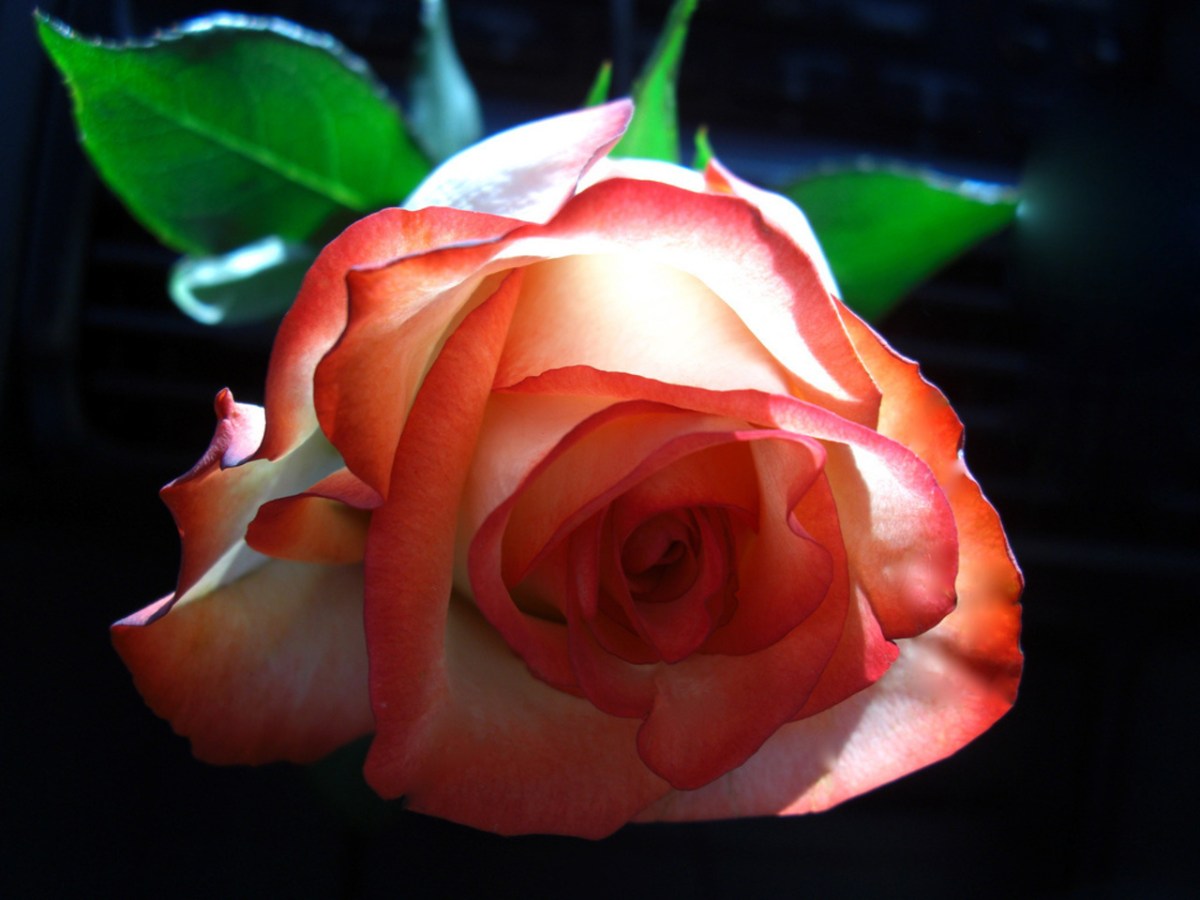
somewhere i have never traveled,gladly beyond
any experience,your eyes have their silence:
in your most frail gesture are things which enclose me,
or which i cannot touch because they are too near

your slightest look easily will unclose me
though i have closed myself as fingers,
you open always petal by petal myself as Spring opens
(touching skilfully,mysteriously)her first rose

or if your wish be to close me, i and
my life will shut very beautifully ,suddenly,
as when the heart of this flower imagines
the snow carefully everywhere descending;

nothing which we are to perceive in this world equals
the power of your intense fragility:whose texture
compels me with the color of its countries,
rendering death and forever with each breathing

(i do not know what it is about you that closes
and opens;only something in me understands
the voice of your eyes is deeper than all roses)
nobody,not even the rain,has such fine hands

e. e. cummings

I love you, Master!

Perceptions in the virtual world

I am continually amazed by how differently people experience the virtual world.

I don’t just mean the surface things like what types of activities and styles people enjoy, whether or not they like to roleplay, or their level of interest in relationships. I am speaking of fundamental differences in the way people perceive the virtual world, and what they value about it. The differences can be so striking that two people may be left staring at each other agape with incomprehension.

I recall the first time I encountered this divergence, when I mentioned my admiration of the builder Painter Meriman’s Craftsman style bungalow, his painstaking attention to the authentic details of the style and his skill with textures and composition. He had displayed it in a street scene, complete with lawn and sprinkler, sidewalk, driveway, fire hydrant, period automobile, and other subtle touches. “It feels so real!” I gushed. “You think you are in a 1920’s suburban neighborhood.” My friend’s face fell. “Oh,” she said. “I’m not interested in things that feel real. That is so boring.” I was very surprised. Her reaction woke me up to the fact that not everyone values what I value.

Recently, another dear friend illustrated the vast differences in our experience of the virtual world when he thought it would be fun to decorate an ancient Roman plaza with a big net that dropped poppable colored balloons all over the ground. I had worked hard to fine-tune the color palette of the plaza so that everything blended harmoniously, and had focused on building within the authenticity of the style. The beauty of the finished product gave me great pleasure, and to me that was worth the work. But the addition of colored balloons completely drained away any joy I felt in the scene, both because they were inauthentic (I can’t be certain but I suspect ancient Romans didn’t go in for balloon drops) and thus made it impossible for my imagination to immerse in the scene, and because the bright colors conflicted in every way with the color palette I had so carefully designed. It was as if I had painted a painting in pastels, and someone thought it would be fun to throw a vat of tomato sauce onto it. Not that I have anything against tomato sauce, but it would kind of ruin the painting, right?

And yet, the same situation looks very different through my friend’s eyes. He is all about fun and play. He loves fantasy and pretending. My friend is an iconoclast, and gets a charge out of turning things upside down just to see what happens. If we both were standing in front of a row of buttons, I would methodically press one at a time to see what each one does—but he would press all of them at once, and if it blew up as a result, it would delight him. For him, my careful attention to authenticity and color feels unpleasantly confining. He does not understand why beauty and style are important to me. He hates it. He yearns to break free of the chains of style, and splatter balloons and paint everywhere. That, for him, is a source of pleasure. The balloons that made my joy evaporate were the balloons that made his joy possible.

Although I found this incident unsettling, it was a good education for me. In the virtual world I have always been drawn to designers and artists. Because, like most people, I tend to hang out with people who are like me, it is easy to forget that not everyone is like me. When encountering someone whose perceptions and values are very different from mine, I go through a kind of progression of understanding, starting with “I don’t get that at all,” then advancing to “I guess I get where he’s coming from, but it’s not for me.”

The danger against which I must constantly guard is that I might be tempted to continue that progression too far, and end up saying, “His point of view is different, and it is wrong / of no value / inferior.” There may be a few things in this life about which such an absolute statement could have merit. But I don’t think that any of them apply in the way we experience the virtual world. There is a difference between saying that you don’t like something, and saying that it is intrinsically bad. Is one way better than another? Is one way right, or wrong? I doubt it. Even if I don’t like them, I do find the differences intriguing.

Have you ever encountered someone who sees the virtual world in a fundamentally different way? How did you react?

.