My Christmas Struggle

grumpy-cat-christmasI struggle a lot with Christmas.

Wait, let me rephrase that. Truthfully, I don’t struggle with Christmas at all. What I struggle with is fitting in during the holiday season.

Nearly everyone else observes Christmas in a completely different way from me. I have reasons for following a different path, but it’s very difficult to hold true to myself without offending the people around me. They tend to think that because I don’t do things their way, I must be criticizing them. I’m not, but their attitudes toward my customs range from indignation to puzzlement. Well, let me try to clear it up.

Up until about 25 years ago, Christmas had a very unpleasant stranglehold on me. Then one year, I finally broke free. At the time, my loved ones thought I’d lost my mind. I hadn’t, but I knew I would lose my mind for sure if I didn’t change my ways.

You see, my family, when I was growing up, was enslaved by a holiday defined by quantity and a drive to impress others with perfect decorations, food, presents and parties. My mother actually counted the number of gifts under our tree as a way of “rating” the quality of that year’s holiday. And it wasn’t only about gifts; to qualify for a “good” Christmas, our house had to be decorated better than any other house, inside and out, and we had to give “the” party of the season with the most impressive gourmet food and drinks. And of course we had to put on a good show, exhibiting “holiday cheer”—whether we felt it, or not.

From the outside it looked great; with decorations, parties and gifts my mother certainly knew how to “impress with excess.” But in the frantic rush to do everything, perform perfectly and be artificially happy, everyone got far too stressed, and made each other thoroughly miserable.

When I became a young adult, not knowing any better I began to duplicate that craziness. I, too, made myself crazy trying to give outrageous gifts and do everything perfectly for the holiday. I didn’t have financial resources like my parents so I tended to spend a lot more money than I should have. As things in my life started going sideways, the stress of trying to be perfect, and exhibit holiday cheer when I felt none became a bigger and bigger burden. Finally, in one particularly depressed year, I couldn’t face it, and I said: no more.

I knew that I had to change. I just wasn’t sure how to do it. My head was swimming, trying to grasp the difference between trying to impress someone, and trying to please them. My mother’s methods had always seemed a little aggressive to me, as if gift-giving were a contest that she was trying to win. It seemed less about pleasing the recipient and more about showing off how much money she had. I knew that was not the way I wanted to keep Christmas. I had to replace that competitive attitude with something more meaningful. I just didn’t know what that was.

The only thing I could think of was to start totally fresh, with a blank slate.

I declared a moratorium. I announced that I would accept no gifts, nor would I be giving any. That year I did not decorate, or prepare any special treats. I had no Christmas tree, did no shopping, and listened to no Christmas music. I rejected all offers of Christmas dinners, parties and other gatherings. It was a truly minimalist Christmas.

christmas-night-skyMy only acknowledgement of that season was going to church on Christmas Eve, alone, in a small church nearby. I didn’t speak to anyone after the midnight service. I slipped out the back, and set out alone to walk the few blocks home. I remember feeling so light, and peaceful. It was a beautiful night, crisp and clear; it needed no artificial decorations to make it beautiful. The sky was deep black, studded with diamond stars, stretching to eternity, more stunning than any Christmas tree. It was still, and quiet. Quiet enough, finally, for me to hear what I needed to hear, without the noise of all that pointless activity. In that silence I felt like an enormous weight had been lifted and I breathed freely of the cold night air, feeling at peace for the first time in a long time.

Wrapped in that crisp, bright darkness, gazing up at the infinite night sky, I suddenly comprehended what it meant for eternity to enter into time. In one blazing flash of insight, I realized that Christmas is about one thing. To immerse myself in that one thing is all that I need. Anything that flows from and serves that one thing is good. Everything else is a distraction.

And at that moment, I realized that I was free.

Since that cold dark night 25 years ago I have settled into my own lovely, small Christmas celebration. Others are welcome to do as they wish, but I know what works for me. I ignore most elements of commercial and secular Christmas, not because there is anything wrong with them, but because I find them irrelevant. I have come to understand what is important for me, and I focus on those things.

Gift giving, for me, now, is not a way to impress, but a way to honor the gift that originated this holiday. I exchange modest gifts with a handful of loved ones, as I am able, not out of any sense of obligation, but because I enjoy pleasing them. My loved ones mostly feel the same, and I am always genuinely pleased by them, too.

I do not decorate. I have no use for Santa, elves, reindeer, or anything else commercial. I don’t object to them, but they are meaningless to me, and certainly not worth expending any money, time, attention or effort. For me, they have nothing to do with the one thing that gives Christmas meaning.

I keep a few quiet traditions that are deeply meaningful to me, but they are private, and ancient, and intimate, and since most people would not understand them, I tend to keep them to myself. I don’t need anyone else to understand them, and I feel no need to convert anyone else to my way of observing the holiday. I do what I do because it’s right for me.

People with families have different priorities, of course, but I feel no pressure to participate in holiday gatherings just because it is Christmas. I treasure time with my loved ones all year long, but I am perfectly comfortable with solitude. In fact, my most intimate Christmas ritual is spent alone, at home, on Christmas Eve morning, listening to a famous radio broadcast. I say alone, but I am not alone. I join an invisible audience of 200 million people who, like me, are in front of radios and computers all over the world, listening to the same broadcast at the same time. Even though I can’t see them, I know we are all attuned to the same thing. I immerse myself in the beauty of that one thing, and I wait to bow my head humbly, honoring that moment when the eternal and the now became one.

That is my Christmas.

I don’t expect anyone to understand it, and certainly don’t expect anyone to change how they celebrate the holiday. Others will find meaning in other ways. But hopefully they will understand that I am not judging or criticizing. I am simply honoring what is meaningful to me.

As the commercial holiday season gets underway, I wish everyone happiness, and joy, and peace.

The Joy-Sorrow Chord

Although I mainly write about the virtual world in this blog, I just want to take a real-world moment to note, with deep sadness, the death of the great composer John Tavener, who was an enormous inspiration to me, both musically and spiritually. I had the privilege of meeting him twice, once when reviewing his Grammy-winning composition Lamentations and Praises, and again when reviewing his epic 7-hour all-night vigil Veil of the Temple.

Tavener lived much of his life close to death due to a serious heart condition, knowing that the end could come any moment. The effect on his music was perhaps surprising; it has a delicate radiance and sense of timelessness, with one foot in this world, and one foot in the next. Listen as Tavener’s music was sung as Princess Diana’s coffin was borne from Westminster Abbey — it was a transcendent moment, beginning in luminous simplicity, soaring ecstatically into a magnificent ray of sunlight as the procession reached the west door. The very simplicity of it allowed millions to weep, pouring their grief and joy into the sound.

Sorrow and joy. It is fitting that I feel both things as I think back on what John Tavener has meant to me. Sometimes I think it would be easier if I could feel just one thing at a time. But sorrow and joy don’t happen one after the other. They seem to happen all at the same time. It’s like being in the midst of an oppressively dark, gloomy day, and suddenly one brilliant shaft of light comes beaming through the clouds. It’s still gloomy; the sunbeam does not dissipate the overcast skies. But it gleams there in the sky, testifying that there is, indeed, sunshine out there, somewhere, hidden behind the dark clouds.

When speaking of joy and sorrow, it is easy to revert to the old metaphor of darkness and light. Black and white. I have been accused, before, of believing in the darkness more than I believe in the light. Of being a pessimist, living with the expectation that the worst will happen. And therefore, somehow, causing it, as if I created the darkness.

I do not really think that is true, any more than I could, somehow, by force of will, have made yesterday’s rain clouds dissipate and turn it into a sunny day. We do not get to have that much control over the world. But that is beside the point.

John TavenerWhich is the truth, darkness or light? If I believe in the dark, does that mean I do not believe in the light? Is it that black and white?


People often speak about things being “black and white,” by which they actually mean something is either black or white. Clearly one thing, or the other. Well, if I have learned anything in this life, it is that almost nothing is clearly black or white. They are not even gray. Almost everything is both black and white at the same time. People, for example, are rarely purely good or purely bad, and also not a neutral-in-the-middle gray; we are all a messy mixture of both good and bad, simultaneously.

Thus it is with life. Almost every moment contains both darkness and light. Distinct, and separate, and coexisting. The via media, the middle road, is not some flat compromise of gray, but a lively tension resulting from the pull of two opposites.

John Tavener, who understood this, portrayed it in music, in his composition Ikon of Light. (Listen to it.) A string trio is the darkness, the soul lost and yearning. This is suddenly interrupted by a choir’s brief, brilliant cry of “Phos” (“Light”). This flash of light is not triumphant; even in its brilliance it is ambivalent. Tavener referred to the expression of “light” as the “joy-sorrow chord.” One chord that contains both joy and sorrow, filled with heartbreaking ecstasy.

That is more how I see it. Every moment contains joy and sorrow, heartbreak and ecstasy, sorrows and songs, darkness and light. Black and white, and every other color besides.

It makes no sense to me to be asked to believe in only one or the other. What seems more likely is that in certain moments, one aspect may be hidden. Yesterday, outside my window, it was a dark, gloomy day. The sun was nowhere to be seen. But even as I sat there in gloom, it was a sunny day. Not right here, perhaps. But if I were to fly high enough, above the clouds, it would have been sunny. Just because I cannot see the sun, right now, does not mean that it is not shining.

The belief that the sun is shining does not make the clouds go away. The presence of the clouds is not something I can control. They are there whether I want them or not. The challenge is to accept that there is sunlight, even though I cannot see it.

The assurance of things hoped for, the conviction of things not seen.

It is not easy. Sometimes I need reminding that there is always, in every moment, both black and white, both sorrows and songs, both darkness and light. The music of John Tavener fills my heart with gratitude like a brilliant ray of light momentarily breaking through the clouds, attesting that there is sunshine out there, somewhere, unseen beyond the dark clouds.

Remembrance

I hate this day.

Twelve years later, how should we continue to observe this tragic day? I will share my own personal opinion, noting that it is mine, applies to me only, and everyone else’s opinion is up to them.

What I hate about this day is the extent to which we allow ourselves to be frozen in grief, or in anger. Both emotions are honorable, appropriate, and good. But if we aren’t mindful, they can define us. Then, every year on this day, we find ourselves observing the occasion by striking out in rage against whoever it is we blame.

To me, that awards a victory to the terrorists.

I’ve never understood how killing someone is supposed to prove that one is better, or stronger. To me it only proves that one is more brutal.

For me… and I emphasize, for ME… the best way to honor this day is to be as unlike those terrorists as I possibly can be. To choose to act in the way that is as different as possible from what they hoped to achieve.

Today, instead of rage, I will embrace compassion. Compassion is the polar opposite of what they wanted us to feel. They expected that we would be enraged, and respond in kind, striking back with brutality as they struck us. But they don’t get to have their way–not from me, anyway.

I have no control over what governments do. I can only control what I do.

So today, instead of tearing down, I am going to build something.

Instead of feeling fear, I am going to do something fun.

Instead of feeling grief, I am going to rejoice in love.

And that is how I defeat terrorists.

Littlefield Grid members observing the day together at the 9-11 Memorial

.

New Horizons

It was late April of 2010 when Walter first led us to explore grids other than Second Life. At that time, visiting other grids was pretty grim for those of us who find our pleasure the virtual world more by art and design than by technology. It’s hard to believe just how far we have come in three short years. What was the barren frontier has become a perfectly reasonable alternative to Second Life.

It’s been awhile since I posted anything about what I have been up to on our grid. So I’m taking this opportunity just to share a few snapshots of what I’ve been building.

In April of 2013, almost exactly 3 years after we first tried Opensim, in a vast leap of faith, we opened our own independent virtual world: Littlefield Grid. Here is our Admin Team arriving at the Grand Opening gala.

littlefield-grand-opening-01

We just added our 500th member a couple of weeks ago, and are closing in on 600 already. Littlefield Grid consists of about 140 regions, centered around a central shopping district and five welcome and hangout regions. The welcome regions include Littlefield Hangout, a beautiful redwood grove.

redwood-grove-littlefield-01

Littlefield Engineering is a hangout for those who like to talk tech. It was my experiment in Brutalist architecture.

littlefield-engineering-brutalist-01littlefield-engineering-brutalist-02

One of Littlefield’s distinctions is our enthusiastic band of content creators. I have built lots of stores for them, where they share their creations with members for free. For me, building a store is often an opportunity to explore a new architectural style. I created a few stores in Art Deco style for my beloved who especially likes that style.

art-deco-littlefield-01art-deco-littlefield-06

One of the biggest challenges, when we left SL for the Opensimulator world, was vegetation. The quality of available landscaping materials in Opensim worlds in 2010 was distressingly poor, especially compared to what was available in SL. But three years later, things are looking up; we now have one whole sim of good plants and decent trees (and they are all free to our residents).

garden-center-littlefield-02

I enjoyed learning about Victorian style when building this Queen Anne and a Victorian shopping street.

victorian-queen-anne-littlefield-01victorian-queen-anne-littlefield-04

One of my most recent builds was a conference center in the style of a mountain lodge – my little homage to the luxury hotels in the National Parks of the Western U.S.

conference-center-lodge-littlefield-01conference-center-lodge-littlefield-02

For more snapshots of Littlefield Grid, with many more photos of my builds, visit Camryn’s Flickr stream.

.

Never stop learning

“No one is good to start with;

It takes practice for your work to match your vision.”

This wisdom comes from the amazing Robin Sojourner, one of the most respected creative forces in the virtual world. Robin’s quietly generous creativity permeates the virtual world through her free scripts and templates, the beautiful things she makes, and her teaching of building and texturing skills. “One of the things that excites me,” she says, “is that people who have no idea that they are creative come into Second Life and find out that they can make things. We are taught, at some point early in life, that creativity is reserved for the ‘creative types’ and they are special and there are only a few of them… and it’s just not true. All of us can do it.”

I was like that. If you’d told me in early 2006 that within a few years I would be so engaged in creating, I would have laughed. But now look. I’ve built whole towns and countless sims, and everything from jewelry to palaces. It turns out I have an eye for fashion and for architecture, something I would never have known about myself, had it not been for the virtual world.

But I think I am not done learning yet.

We have a similar creative force on Littlefield Grid, the marvelous Aaack Aardvark, who is generously giving his time to teach us how to make things in mesh. Our classes are fun and enlightening, and Aaack is a wonderful teacher who keeps us laughing. I am having a great time. The learning curve will not be easy, but with help, who knows. Maybe I can finally make a tree that satisfies me. Maybe more.

The day that you stop learning is the day that you start dying. Keep opening yourself to new things.


Real Virtual People

How “real” is the virtual world? Is it more than a cartoon, a video game or a fantasy? And what does “real” mean, anyway?

Is this place realThere are many shades of real.

We might say that something is “realistic” if it closely resembles reality. Subtle shading and shadows in the corners of a room, or motion capture animation may make a scene look “almost like” the real thing. To say something is “realistic” acknowledges the craftsmanship of its creator. But saying that something is “almost like” the real thing is an admission that it’s not the real thing. It may resemble a real tree, but it is not, in fact, a physically real tree—it is a collection of pixels. I don’t think very many people believe that the virtual world is the same as the physical world.

That doesn’t mean it’s not real.

Whether or not it’s physically real, the virtual environment can affect us physically. It’s like when a skillful filmmaker weaves together story, cinematography, acting and other elements to make light, color and motion affect us emotionally, and even physically if we recoil in a horror movie or weep over a sad ending. In the same way, a well crafted scene in a virtual world can evoke real-world physical sensation and emotion. The serenity of a quiet virtual forest, under a protective canopy of giant trees, with sounds of birds, brooks and breezes actually calms my physical body in the “real” world. The desolation of a vacant shack on a dry, windswept plain makes me cough as if I can feel the swirling dust catch in my throat. Standing around in a virtual snow scene makes me feel cold in the physical world—and putting a sweater on my avatar warms me up.

Of course there is the whole matter of virtual sex and BDSM, and the very real arousal it can incite. “In the real world, arousal mostly happens between your ears anyway,” a friend of mine said recently. “Virtual sex is just like physical sex—but with better animations!”

We all know that the emotions we experience through our encounters in the virtual world are real. The whole gamut, from mirth to rage, wonder to repulsion, heartbreak to love—yes, love—all just as authentic as if they were triggered by events in the physical world. And the qualities of the human spirit we encounter are also real: generosity, creativity, selflessness and selfishness, forthrightness and deceit.

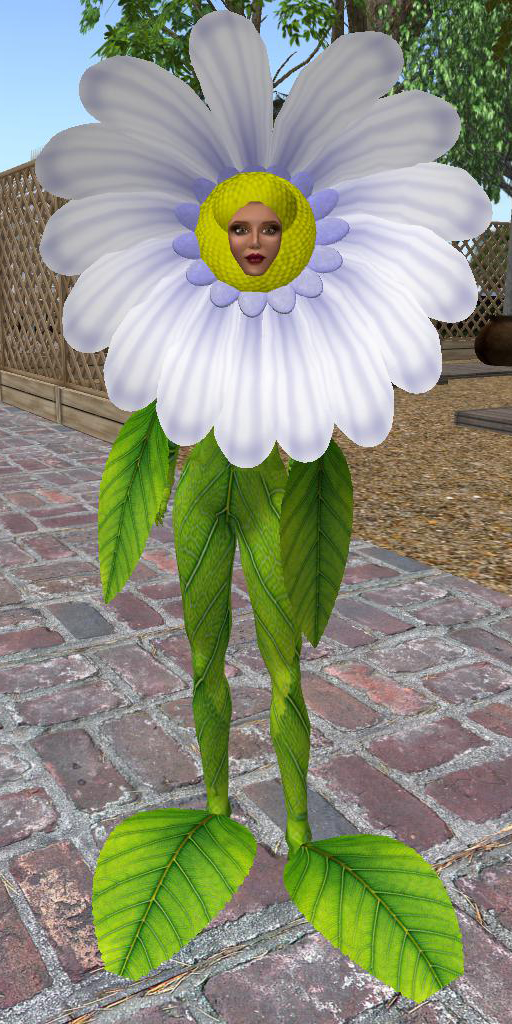
Flower AvatarSo, is the virtual world real?

A better question would be: are your experiences real? Does the virtual world evoke real emotions and sensations? Is pleasure real? Is inspiration real? Is friendship real? Is excitement real? Is beauty real? Is laughter real? Are art, craftsmanship and creativity real? Dare I ask: is love real?

Some people ascribe no reality to the virtual world; they see it as a cartoon, with no value in and of itself. They treat it as if it were only a screen separating them from other “real” people. They seem impatient, then, to get past this screen and connect with a physical person, who is, to them, the only person who matters. These are people who typically don’t put much effort into their avatar, since the virtual world is not important to them. They don’t care about their avatar, or yours, but they are very interested in who you are in “real” life, where you live, what you look like, how old you are, etc. For them, the virtual world is not real at all. For them, the physical world is the only reality.

On the other end of the continuum, some of us inject so much of our conscious awareness into our avatar that our physical self becomes secondary. As in the movie “Surrogates” I live through my avatar much more than through my physical self. If you only know me in the physical world, you don’t really know me. Camryn Darkstone is the “real” me. In the virtual world, I am freed from some of my physical limitations and allowed to be my most authentic self. Of course it can’t be carried to extremes, since I do enjoy some pleasures with my physical body that aren’t available in the virtual world, for example singing and food. But in terms of my sense of self, and everything else that is most important, I am much more present as Camryn Darkstone.

For others, the avatar is a fantasy, a character they have created, through which they role-play. Some even view the avatar as a separate person, with a life of its own. I know at least one person who, when speaking as his avatar, refers to himself in the third person, as though he and his avatar were two different people. The avatar refers to “that person behind the keyboard” as if it were someone else.

virtual-worldI can’t wrap my mind around that kind of disconnection. For me, there is no boundary between myself and Camryn Darkstone. I am Camryn Darkstone. Camryn Darkstone is real. In fact, Camryn Darkstone is much more real than my physical self. Camryn Darkstone is a better representation of my sense of self than my physical presence.

The seamlessness between virtual and physical has been enhanced since I accepted my Master’s collar. He is a TPE Master—Total Power Exchange—and he is my Master all the time, 24/7, not just for the duration of a scene. I don’t segment off certain areas of my life for him to dominate. He has total access. He gets to be in charge of every part of my life, virtual and physical. So the seamlessness between the virtual and physical aspects of my life is strengthened even further by him.

It is also strengthened by the culture of our family. Whereas many people draw strict boundaries of anonymity and privacy when interacting in the virtual world, within my family we are very open. Each of them, for me, is the same type of blended virtual-physical person as I am. We don’t role-play, we are our authentic selves. I voice with them. They know my real name, and some even know my address (and are likely to send me mail order gifts, as I do for them). My Master has been to my home. They know what I look like, where I work and what I do for enjoyment. And yet, even with all of this “real” world information, I am still Camryn Darkstone to them. I am one person—submissive, builder, tree lover, horse racing enthusiast, fashionista, bourbon connoisseur, anglophile, musician. This—all of this, virtual and physical—is Camryn Darkstone.

I am not a virtual person. I am a real person in a virtual world—a real person whose real life is extended, enriched and enhanced beyond the limits of the so-called “real” world.

I thought it was just me

If we ever got honest enough to go out in the streets and uncover our common grief, we would discover that we are all grieving over the same things.

–Miguel Unamuno

shared-sorrowWe all know people who are a little too generous in sharing their troubles. On the other hand, there are those tight-lipped souls who refuse to share anything at all. I’m not sure which is more frustrating.

How often do we try to mask our heartbreak with a veneer of cheerfulness? Sometimes “official smiles” are necessary when you have to function professionally despite being in pain. At other times, I may do it to protect my privacy. It is not everyone’s business to know whether or not I am upset about something.

But in the context of an intimate relationship, whether a close friendship, romantic or D/s relationship, I am not sure that “official smiles” are helpful–or even effective. The people who know you know if something is wrong, no matter how brightly you are smiling. They may just feel the subconscious tingle of discomfort that comes from knowing that something is wrong and you are concealing the truth. Or if they realize that you aren’t telling them what’s troubling you, they may feel hurt at being shut out. Or if they are paranoid, like me, they may not be able to stop their imagination from worrying whether they caused your pain.

So before you “put on a brave face” and hide your sorrow, take a moment to consider if doing so will protect those close to you–or hurt them.

Nobody owes it to me to reveal their troubles. I have no right to demand it. But with those I love, I am always hopeful. I want my dear ones to tell me when they are upset. It’s not a burden. Actually, the honesty is a relief. And when they choose to share their pain, I am honored. I will listen with an open heart, and will not judge. I probably can’t take away their pain. But I can care. I can be with them in it, and support them with my love.

My belief is that love is stronger than sorrow. The only thing worse than being in pain is being in pain alone. Not everyone is able to help. But there are people who will listen, and not judge, or argue, or try to talk you out of your feelings. They will simply care about you, and for you. I try to be one of those people.

When your heart is aching with disappointment and sorrow, it does not make you weak, or flawed, or needy. It makes you the same as every other human being on the planet. We are all grieving. That ache in your heart resonates with the ache in my heart. And when that happens, by being open with each other about it, we both might find strength and healing in our common grief.

.

Expectations

firebird

“Expectations are limiting.”

I have said this before, but in our goal-oriented world, my assertion is usually met with blank, uncomprehending stares, or polite dismissal.

It is fashionable to have expectations. We are supposed to decide what we want, and go after it. Admiration is lavished upon those who achieve their goals, and get what they want.

The problem is that most of us get so focused on achieving our goals that we totally miss glorious surprises that don’t fit into the preconceived plan. When something comes along that isn’t what we set out to achieve, it is too easy to simply dismiss it as irrelevant.

But what if this unexpected development is actually better than our original goal?

Not only do we miss glorious surprises, we may get mired in the negative emotional energy of resentment, frustration and disappointment. I have known so many people who seem never to see or appreciate what they do have. Instead they can only think about what they don’t have.

When I was younger, I had goals and expectations. Almost none of them came to fruition. My life has turned out very differently from what I imagined it would be.

The way I see it, I have a choice. I can be sad and resentful that I didn’t get the life I wanted. Or: I can pay attention and notice all the wonderful things I do have… and be grateful.

My life isn’t what I wanted.

It’s better.

Let go of the limits of expectations. Have enough humility to admit to yourself that you don’t know everything. Accept that you may not be able to know, in advance, exactly what the best outcome is. Have aspirations, but be mindful that there might be something even better waiting for you, something you can’t envision or predict. Be open to the possibility that you will be surprised by something wonderful you could never have imagined. Open your eyes, and your heart, to the surprise and delight of unexpected pleasure.