Do It Anyway

It is a sad fact of life that “no good deed goes unpunished.”

Perhaps you have done a kindness by helping someone in need, as Androcles removed the thorn from the lion’s paw. But for every Androcles, whose lion repaid his kindness, there are ten who are attacked by the one they tried to help.

Some good Samaritans get so discouraged when this happens that they just give up, and stop helping others. If our motivation in doing kindness is to get a reward—even the reward of gratitude—we often will be disappointed.

Instead, we do kind things because that is the person we want to be. Do it for ourselves. Do it for our sense of self worth, our self respect. Do it for one’s own sake.

In his 1968 booklet, “The Silent Revolution,” Kent Keith advised, “give of your time and effort because you care and want to give, not because you are expecting anything in return… Do things because you believe in them, and the simple satisfaction of having achieved them will be enough.”

He goes on to admit that helping others often results in being attacked and mistreated by those you are trying to help. But his response was not disappointment. Instead, he proposed “Ten Paradoxical Commandments,” that rang so true even Mother Teresa posted them on the wall of her orphanage.

People are often illogical, unreasonable, and self-centered.
Forgive them anyway.

If you are kind, people may accuse you of selfish ulterior motives.
Be kind anyway.

If you are honest and sincere, people may cheat you.
Be honest and sincere anyway.

If you are successful, you may win false friends and true enemies.
Succeed anyway.

The good you do today may be forgotten tomorrow.
Do good anyway.

What you spend years building may be destroyed overnight.
Build anyway.

If you find serenity and happiness, some may be jealous.
Be happy anyway.

Give the world the best you have, and it may never be enough.
Give it anyway.

We show kindness to a lot of people on Littlefield Grid. We give of ourselves without any expectation of reward or profit. Sometimes, our kindness is repaid with gratitude. But that’s not why we do it. We extend kindness because that’s who we want to be.

Sometimes, we are repaid with thoughtlessness; and, on a few rare occasions, hurtfulness from the very people we helped. Thankfully, we have some terrific folks in our community, and that rarely happens. When it does, we could be resentful. But we aren’t. We keep right on extending kindness. And we always will.

We do it anyway.

.

My Christmas Struggle

grumpy-cat-christmasI struggle a lot with Christmas.

Wait, let me rephrase that. Truthfully, I don’t struggle with Christmas at all. What I struggle with is fitting in during the holiday season.

Nearly everyone else observes Christmas in a completely different way from me. I have reasons for following a different path, but it’s very difficult to hold true to myself without offending the people around me. They tend to think that because I don’t do things their way, I must be criticizing them. I’m not, but their attitudes toward my customs range from indignation to puzzlement. Well, let me try to clear it up.

Up until about 25 years ago, Christmas had a very unpleasant stranglehold on me. Then one year, I finally broke free. At the time, my loved ones thought I’d lost my mind. I hadn’t, but I knew I would lose my mind for sure if I didn’t change my ways.

You see, my family, when I was growing up, was enslaved by a holiday defined by quantity and a drive to impress others with perfect decorations, food, presents and parties. My mother actually counted the number of gifts under our tree as a way of “rating” the quality of that year’s holiday. And it wasn’t only about gifts; to qualify for a “good” Christmas, our house had to be decorated better than any other house, inside and out, and we had to give “the” party of the season with the most impressive gourmet food and drinks. And of course we had to put on a good show, exhibiting “holiday cheer”—whether we felt it, or not.

From the outside it looked great; with decorations, parties and gifts my mother certainly knew how to “impress with excess.” But in the frantic rush to do everything, perform perfectly and be artificially happy, everyone got far too stressed, and made each other thoroughly miserable.

When I became a young adult, not knowing any better I began to duplicate that craziness. I, too, made myself crazy trying to give outrageous gifts and do everything perfectly for the holiday. I didn’t have financial resources like my parents so I tended to spend a lot more money than I should have. As things in my life started going sideways, the stress of trying to be perfect, and exhibit holiday cheer when I felt none became a bigger and bigger burden. Finally, in one particularly depressed year, I couldn’t face it, and I said: no more.

I knew that I had to change. I just wasn’t sure how to do it. My head was swimming, trying to grasp the difference between trying to impress someone, and trying to please them. My mother’s methods had always seemed a little aggressive to me, as if gift-giving were a contest that she was trying to win. It seemed less about pleasing the recipient and more about showing off how much money she had. I knew that was not the way I wanted to keep Christmas. I had to replace that competitive attitude with something more meaningful. I just didn’t know what that was.

The only thing I could think of was to start totally fresh, with a blank slate.

I declared a moratorium. I announced that I would accept no gifts, nor would I be giving any. That year I did not decorate, or prepare any special treats. I had no Christmas tree, did no shopping, and listened to no Christmas music. I rejected all offers of Christmas dinners, parties and other gatherings. It was a truly minimalist Christmas.

christmas-night-skyMy only acknowledgement of that season was going to church on Christmas Eve, alone, in a small church nearby. I didn’t speak to anyone after the midnight service. I slipped out the back, and set out alone to walk the few blocks home. I remember feeling so light, and peaceful. It was a beautiful night, crisp and clear; it needed no artificial decorations to make it beautiful. The sky was deep black, studded with diamond stars, stretching to eternity, more stunning than any Christmas tree. It was still, and quiet. Quiet enough, finally, for me to hear what I needed to hear, without the noise of all that pointless activity. In that silence I felt like an enormous weight had been lifted and I breathed freely of the cold night air, feeling at peace for the first time in a long time.

Wrapped in that crisp, bright darkness, gazing up at the infinite night sky, I suddenly comprehended what it meant for eternity to enter into time. In one blazing flash of insight, I realized that Christmas is about one thing. To immerse myself in that one thing is all that I need. Anything that flows from and serves that one thing is good. Everything else is a distraction.

And at that moment, I realized that I was free.

Since that cold dark night 25 years ago I have settled into my own lovely, small Christmas celebration. Others are welcome to do as they wish, but I know what works for me. I ignore most elements of commercial and secular Christmas, not because there is anything wrong with them, but because I find them irrelevant. I have come to understand what is important for me, and I focus on those things.

Gift giving, for me, now, is not a way to impress, but a way to honor the gift that originated this holiday. I exchange modest gifts with a handful of loved ones, as I am able, not out of any sense of obligation, but because I enjoy pleasing them. My loved ones mostly feel the same, and I am always genuinely pleased by them, too.

I do not decorate. I have no use for Santa, elves, reindeer, or anything else commercial. I don’t object to them, but they are meaningless to me, and certainly not worth expending any money, time, attention or effort. For me, they have nothing to do with the one thing that gives Christmas meaning.

I keep a few quiet traditions that are deeply meaningful to me, but they are private, and ancient, and intimate, and since most people would not understand them, I tend to keep them to myself. I don’t need anyone else to understand them, and I feel no need to convert anyone else to my way of observing the holiday. I do what I do because it’s right for me.

People with families have different priorities, of course, but I feel no pressure to participate in holiday gatherings just because it is Christmas. I treasure time with my loved ones all year long, but I am perfectly comfortable with solitude. In fact, my most intimate Christmas ritual is spent alone, at home, on Christmas Eve morning, listening to a famous radio broadcast. I say alone, but I am not alone. I join an invisible audience of 200 million people who, like me, are in front of radios and computers all over the world, listening to the same broadcast at the same time. Even though I can’t see them, I know we are all attuned to the same thing. I immerse myself in the beauty of that one thing, and I wait to bow my head humbly, honoring that moment when the eternal and the now became one.

That is my Christmas.

I don’t expect anyone to understand it, and certainly don’t expect anyone to change how they celebrate the holiday. Others will find meaning in other ways. But hopefully they will understand that I am not judging or criticizing. I am simply honoring what is meaningful to me.

As the commercial holiday season gets underway, I wish everyone happiness, and joy, and peace.
Virtual Thanksgiving

As a solitary person with no “real-world” relatives, my observance of Thanksgiving differs from most. I have RL friends who are as family to me, but for the past several years circumstances have prevented us from celebrating holidays together. Since coming to the virtual world in 2006, my Thanksgiving has been almost entirely virtual.

In the early years, I sat down for a virtual dinner with one or two friends.

Image

Thanksgiving 2009

Then after Master took me as his, we had very lovely Thanksgiving dinners in our home in Second Life.

Image

You may think a virtual feast is easy, but I worked hard cooking the meal!

Image

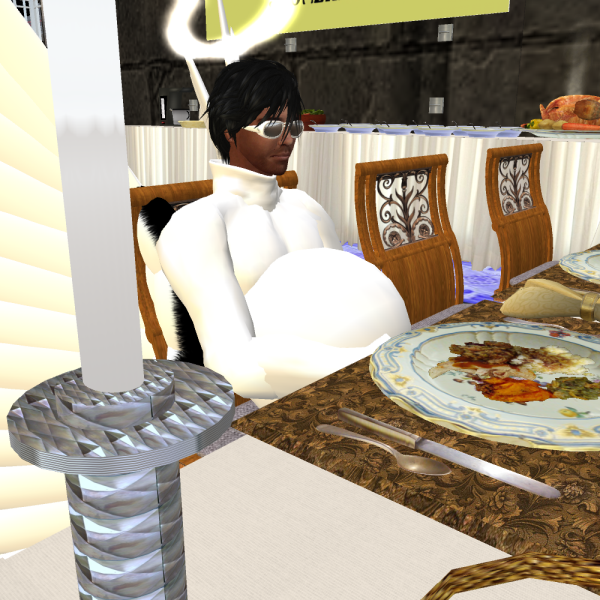
Today in Littlefield Grid, our “family” has widened to include everyone on the grid. We have a table set up at Stonehaven and some folks dropped by to share good conversation and friendship.

Image

Apparently the virtual meal is still quite satisfying!

Image

I am so grateful for all the fabulous people I have known in the virtual world. Thank you, each and every one of you, for the beauty and joy and fun you have brought into my life. And thank you, Master, for loving me–it is what makes everything possible.

.

The Joy-Sorrow Chord

Although I mainly write about the virtual world in this blog, I just want to take a real-world moment to note, with deep sadness, the death of the great composer John Tavener, who was an enormous inspiration to me, both musically and spiritually. I had the privilege of meeting him twice, once when reviewing his Grammy-winning composition Lamentations and Praises, and again when reviewing his epic 7-hour all-night vigil Veil of the Temple.

Tavener lived much of his life close to death due to a serious heart condition, knowing that the end could come any moment. The effect on his music was perhaps surprising; it has a delicate radiance and sense of timelessness, with one foot in this world, and one foot in the next. Listen as Tavener’s music was sung as Princess Diana’s coffin was borne from Westminster Abbey — it was a transcendent moment, beginning in luminous simplicity, soaring ecstatically into a magnificent ray of sunlight as the procession reached the west door. The very simplicity of it allowed millions to weep, pouring their grief and joy into the sound.

Sorrow and joy. It is fitting that I feel both things as I think back on what John Tavener has meant to me. Sometimes I think it would be easier if I could feel just one thing at a time. But sorrow and joy don’t happen one after the other. They seem to happen all at the same time. It’s like being in the midst of an oppressively dark, gloomy day, and suddenly one brilliant shaft of light comes beaming through the clouds. It’s still gloomy; the sunbeam does not dissipate the overcast skies. But it gleams there in the sky, testifying that there is, indeed, sunshine out there, somewhere, hidden behind the dark clouds.

When speaking of joy and sorrow, it is easy to revert to the old metaphor of darkness and light. Black and white. I have been accused, before, of believing in the darkness more than I believe in the light. Of being a pessimist, living with the expectation that the worst will happen. And therefore, somehow, causing it, as if I created the darkness.

I do not really think that is true, any more than I could, somehow, by force of will, have made yesterday’s rain clouds dissipate and turn it into a sunny day. We do not get to have that much control over the world. But that is beside the point.

John TavenerWhich is the truth, darkness or light? If I believe in the dark, does that mean I do not believe in the light? Is it that black and white?

People often speak about things being “black and white,” by which they actually mean something is either black or white. Clearly one thing, or the other. Well, if I have learned anything in this life, it is that almost nothing is clearly black or white. They are not even gray. Almost everything is both black and white at the same time. People, for example, are rarely purely good or purely bad, and also not a neutral-in-the-middle gray; we are all a messy mixture of both good and bad, simultaneously.

Thus it is with life. Almost every moment contains both darkness and light. Distinct, and separate, and coexisting. The via media, the middle road, is not some flat compromise of gray, but a lively tension resulting from the pull of two opposites.

John Tavener, who understood this, portrayed it in music, in his composition Ikon of Light. (Listen to it.) A string trio is the darkness, the soul lost and yearning. This is suddenly interrupted by a choir’s brief, brilliant cry of “Phos” (“Light”). This flash of light is not triumphant; even in its brilliance it is ambivalent. Tavener referred to the expression of “light” as the “joy-sorrow chord.” One chord that contains both joy and sorrow, filled with heartbreaking ecstasy.

That is more how I see it. Every moment contains joy and sorrow, heartbreak and ecstasy, sorrows and songs, darkness and light. Black and white, and every other color besides.

It makes no sense to me to be asked to believe in only one or the other. What seems more likely is that in certain moments, one aspect may be hidden. Yesterday, outside my window, it was a dark, gloomy day. The sun was nowhere to be seen. But even as I sat there in gloom, it was a sunny day. Not right here, perhaps. But if I were to fly high enough, above the clouds, it would have been sunny. Just because I cannot see the sun, right now, does not mean that it is not shining.

The belief that the sun is shining does not make the clouds go away. The presence of the clouds is not something I can control. They are there whether I want them or not. The challenge is to accept that there is sunlight, even though I cannot see it.

The assurance of things hoped for, the conviction of things not seen.

It is not easy. Sometimes I need reminding that there is always, in every moment, both black and white, both sorrows and songs, both darkness and light. The music of John Tavener fills my heart with gratitude like a brilliant ray of light momentarily breaking through the clouds, attesting that there is sunshine out there, somewhere, unseen beyond the dark clouds.

http://www.youtube.com/watch?v=zhKeEt0o0B8

Ocean City Music Pier

I went on a bit of a building bender the past few days. To all the people who kept trying to chat with me, I offer my deepest apologies. Please don’t take my non-responsiveness personally. When I get my head down and totally focused on a project, I’m completely engaged in it and find it impossible to pay attention to anything else. Including things like eating, sleeping, etc.

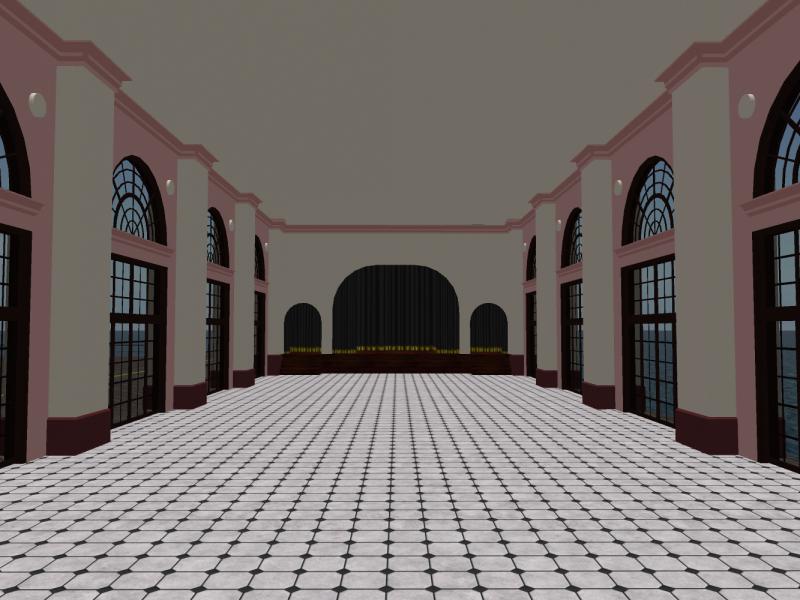
My latest obsession, at Master’s suggestion, pays tribute to the Ocean City Music Pier, an iconic auditorium on the beach in Ocean City, NJ, vintage 1928. This is one of my contributions to our new Jersey Shore regions.

Ocean City Music Pier, Littlefield

I call it “tribute” rather than reproduction because I had to make a few major adjustments due to space restrictions. But yes, it sits on a pier off the boardwalk, and yes, it has an auditorium with a stage. And I did my best to capture the essence of the architecture, if not the real-life layout.

Here’s the real one, interspersed with photos of my “homage”:

Music Pier 2

Music Pier 5

I’ll take another, better photo once I have a chance to add the last few decor items, some accent lighting, etc.

“Tribute to Ocean City Music Pier” weighs in at 3030 prims, not counting the working stage curtains and doors. Gotta love building in Opensimulator!

Have you ever been to the real Ocean City Music Pier? I’d love to hear about your experience.

.

Remembrance

I hate this day.

Twelve years later, how should we continue to observe this tragic day? I will share my own personal opinion, noting that it is mine, applies to me only, and everyone else’s opinion is up to them.

What I hate about this day is the extent to which we allow ourselves to be frozen in grief, or in anger. Both emotions are honorable, appropriate, and good. But if we aren’t mindful, they can define us. Then, every year on this day, we find ourselves observing the occasion by striking out in rage against whoever it is we blame.

To me, that awards a victory to the terrorists.

I’ve never understood how killing someone is supposed to prove that one is better, or stronger. To me it only proves that one is more brutal.

For me… and I emphasize, for ME… the best way to honor this day is to be as unlike those terrorists as I possibly can be. To choose to act in the way that is as different as possible from what they hoped to achieve.

Today, instead of rage, I will embrace compassion. Compassion is the polar opposite of what they wanted us to feel. They expected that we would be enraged, and respond in kind, striking back with brutality as they struck us. But they don’t get to have their way–not from me, anyway.

I have no control over what governments do. I can only control what I do.

So today, instead of tearing down, I am going to build something.

Instead of feeling fear, I am going to do something fun.

Instead of feeling grief, I am going to rejoice in love.

And that is how I defeat terrorists.

Littlefield Grid members observing the day together at the 9-11 Memorial

.

New Horizons

It was late April of 2010 when Walter first led us to explore grids other than Second Life. At that time, visiting other grids was pretty grim for those of us who find our pleasure the virtual world more by art and design than by technology. It’s hard to believe just how far we have come in three short years. What was the barren frontier has become a perfectly reasonable alternative to Second Life.

It’s been awhile since I posted anything about what I have been up to on our grid. So I’m taking this opportunity just to share a few snapshots of what I’ve been building.

In April of 2013, almost exactly 3 years after we first tried Opensim, in a vast leap of faith, we opened our own independent virtual world: Littlefield Grid. Here is our Admin Team arriving at the Grand Opening gala.

littlefield-grand-opening-01

We just added our 500th member a couple of weeks ago, and are closing in on 600 already. Littlefield Grid consists of about 140 regions, centered around a central shopping district and five welcome and hangout regions. The welcome regions include Littlefield Hangout, a beautiful redwood grove.

redwood-grove-littlefield-01

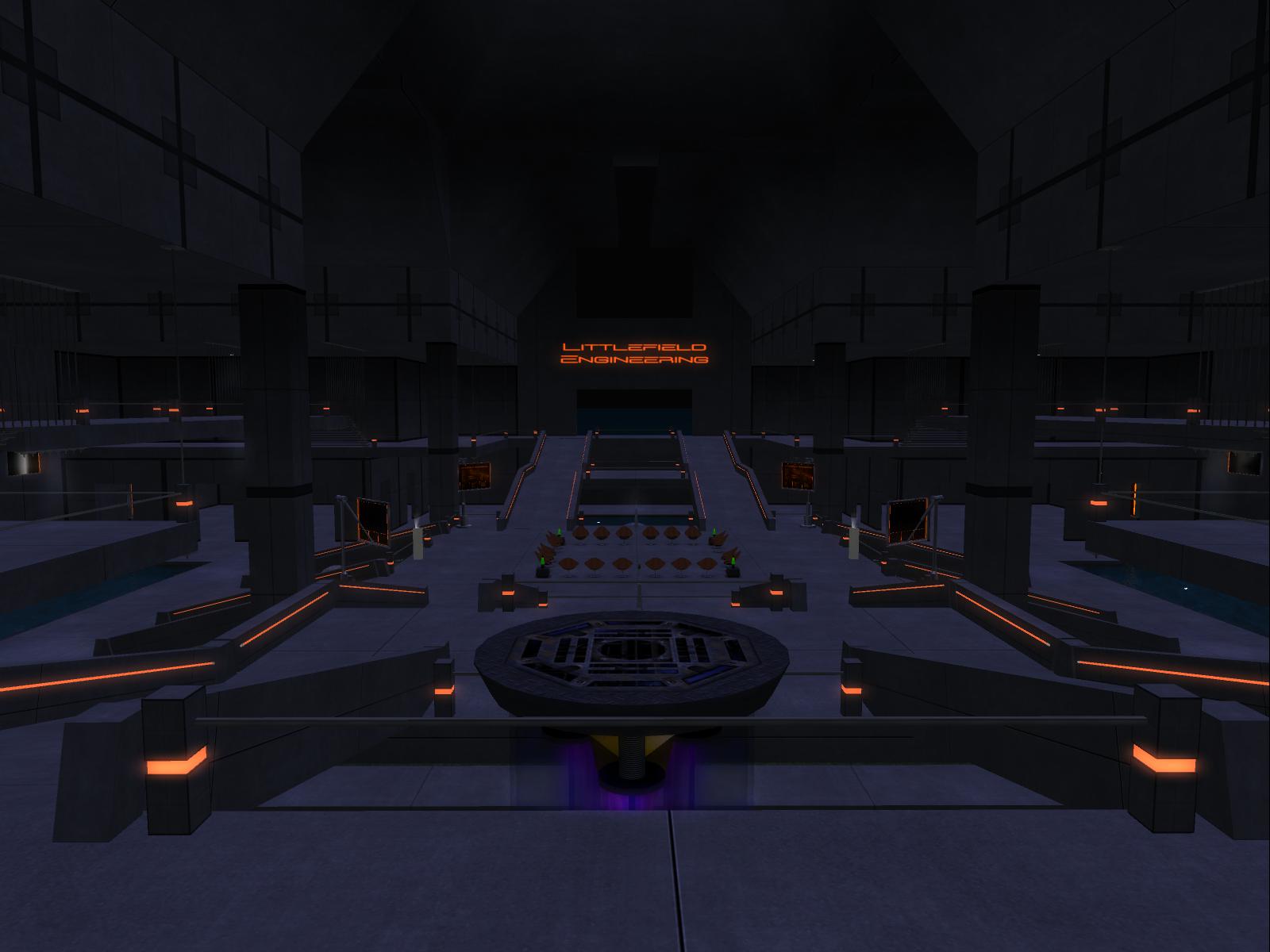
Littlefield Engineering is a hangout for those who like to talk tech. It was my experiment in Brutalist architecture.

littlefield-engineering-brutalist-01littlefield-engineering-brutalist-02

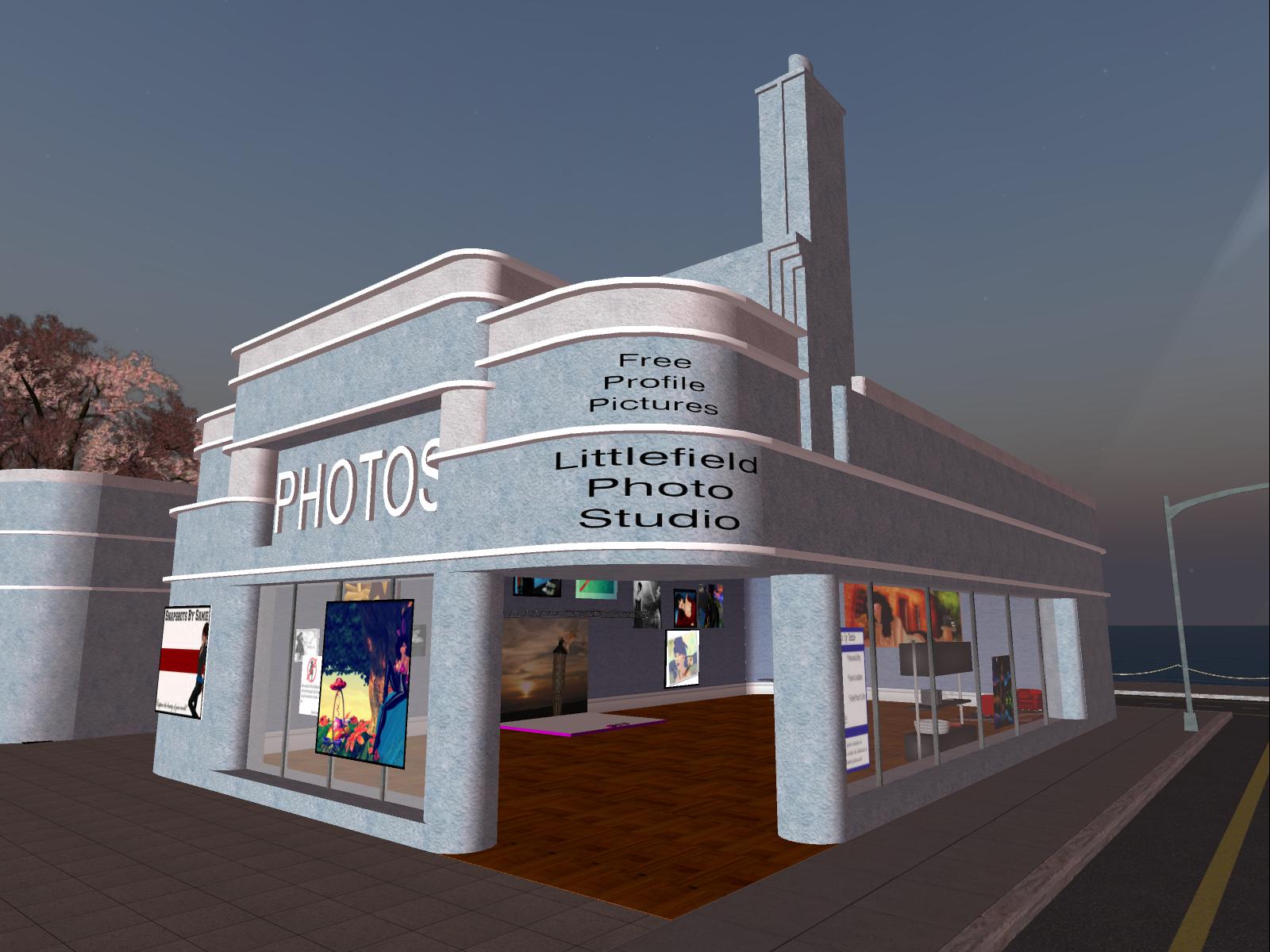
One of Littlefield’s distinctions is our enthusiastic band of content creators. I have built lots of stores for them, where they share their creations with members for free. For me, building a store is often an opportunity to explore a new architectural style. I created a few stores in Art Deco style for my beloved who especially likes that style.

art-deco-littlefield-01art-deco-littlefield-06

One of the biggest challenges, when we left SL for the Opensimulator world, was vegetation. The quality of available landscaping materials in Opensim worlds in 2010 was distressingly poor, especially compared to what was available in SL. But three years later, things are looking up; we now have one whole sim of good plants and decent trees (and they are all free to our residents).

garden-center-littlefield-02

I enjoyed learning about Victorian style when building this Queen Anne and a Victorian shopping street.

victorian-queen-anne-littlefield-01victorian-queen-anne-littlefield-04

One of my most recent builds was a conference center in the style of a mountain lodge – my little homage to the luxury hotels in the National Parks of the Western U.S.

conference-center-lodge-littlefield-01conference-center-lodge-littlefield-02

For more snapshots of Littlefield Grid, with many more photos of my builds, visit Camryn’s Flickr stream.

.

Never stop learning

“No one is good to start with;

It takes practice for your work to match your vision.”

This wisdom comes from the amazing Robin Sojourner, one of the most respected creative forces in the virtual world. Robin’s quietly generous creativity permeates the virtual world through her free scripts and templates, the beautiful things she makes, and her teaching of building and texturing skills. “One of the things that excites me,” she says, “is that people who have no idea that they are creative come into Second Life and find out that they can make things. We are taught, at some point early in life, that creativity is reserved for the ‘creative types’ and they are special and there are only a few of them… and it’s just not true. All of us can do it.”

I was like that. If you’d told me in early 2006 that within a few years I would be so engaged in creating, I would have laughed. But now look. I’ve built whole towns and countless sims, and everything from jewelry to palaces. It turns out I have an eye for fashion and for architecture, something I would never have known about myself, had it not been for the virtual world.

But I think I am not done learning yet.

We have a similar creative force on Littlefield Grid, the marvelous Aaack Aardvark, who is generously giving his time to teach us how to make things in mesh. Our classes are fun and enlightening, and Aaack is a wonderful teacher who keeps us laughing. I am having a great time. The learning curve will not be easy, but with help, who knows. Maybe I can finally make a tree that satisfies me. Maybe more.

The day that you stop learning is the day that you start dying. Keep opening yourself to new things.


Ten Years

I spend more time than ever in the virtual world these days, mostly in Littlefield Grid. But today I took some time in good old Second Life, to observe the 10th anniversary of the official launch on June 23, 2003. After all, Second Life is where I was born.

It is easy to be critical of Second Life. Those of us who inhabit the OpenSimulator world, especially, often are. But I have to admit that I was moved by my experience today. Let me explain why.

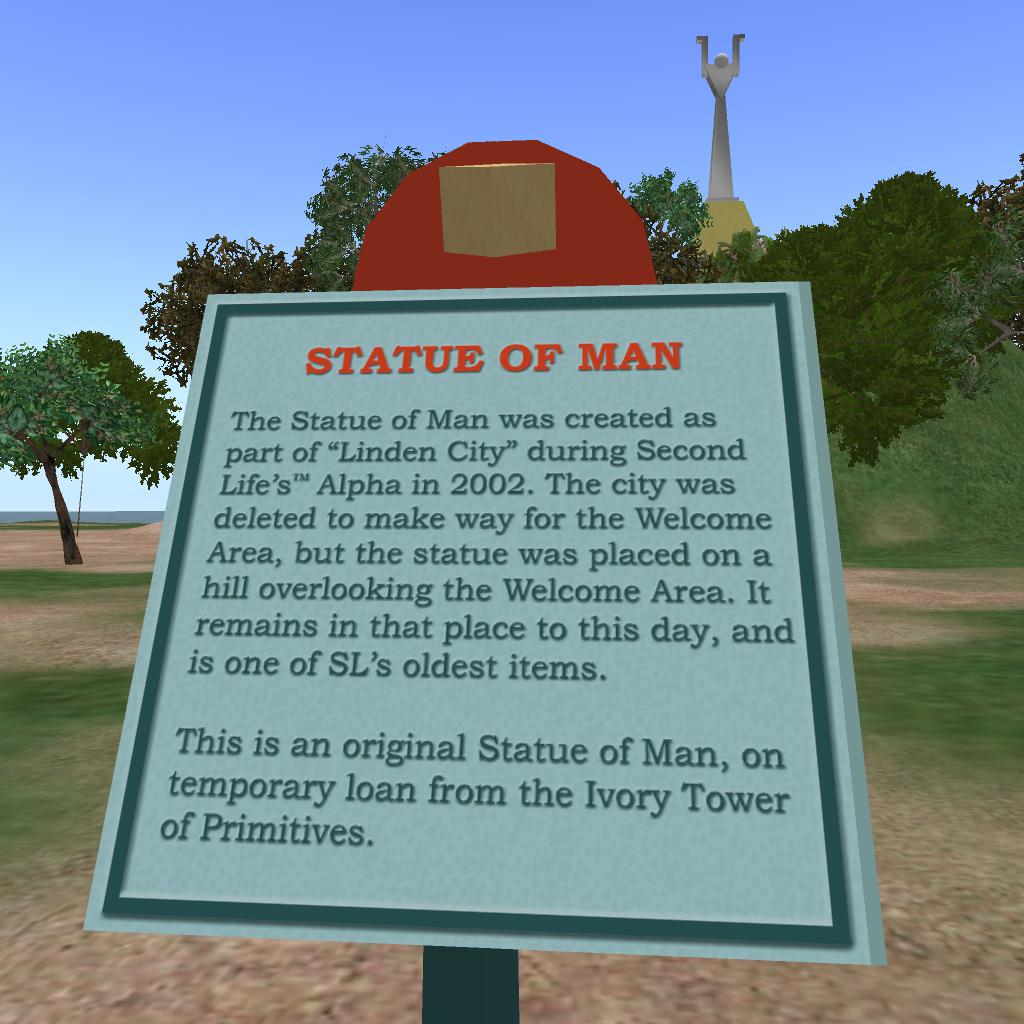
Statue of Man 2002When speaking of Second Life, it is important to draw a distinction between Linden Lab—the commercial entity that created the Second Life software—and the residents, the community of people who created essentially everything that is IN Second Life.

I am no fan of Linden Lab. In my opinion, Second Life is one of the most spectacularly mismanaged businesses in the history of business. Their chronically poor judgment has alienated countless thousands of contributors to the virtual world, and kept the company on the edge of disaster for years.

But somehow, after ten years, the place is still standing, at least for now. Despite inept management, over a million people still log in to Second Life at least once a month. Why? Those one million people are not visiting Second Life because of technology. What keeps them coming back? They come because of people: the residents, the community, the world that has been created, not by Linden Lab, but by people like you and me.

Linden Lab is not Second Life. We are.

Second Life’s 10th Birthday was, for me, a celebration of the mind-bending creativity of the residents of the virtual world (every virtual world, not only Second Life). Seeing it showcased all in one place made it clear just how deep the talent pool is. I was awed by resident creativity expressed in immersive 3-D art… streaming media, machinima, radio and television stations… vehicles, from cars to sailboats to rocket ships… relationships: communities, friendships, romance and sex… battle weapons from swords to It all started with a cube.tanks… animations for every conceivable activity… a massive virtual fashion industry fueling $32 billion USD in virtual goods transactions… deep and complex roleplay communities… education, and charitable fundraising… scripts that enable intriguing things to happen… exquisite textures and building materials… cities and landscapes in astonishing variety… every conceivable environment from castles to post-apocalyptic ruins, bayou shacks to gleaming palaces, and everything in between… and ideas, omg, incredibly creative and innovative ideas.

These are the components of the virtual world, and they were not created by Linden Lab. They were created by us—the users, the residents, the virtual world community. This is what inspired me today. Not Linden Lab, but imagination and the human spirit.

On the occasion of the 10th anniversary of the official launch of Second Life, I celebrate the creativity of 30 million human beings who have lived in this and every other virtual world. I toast their thought, their craft, their innovation, their art and their science. I praise the generosity of spirit that inspires me every day, when people pull amazingly wonderful and original ideas out of their minds, and share them with the rest of us in Second Life, in Littlefield, and in every virtual world.

Let us raise a glass to creativity! Hear, hear!

.