New shoes make everything better!

New shoes make everything better!

We, all of us, are a messy mix of virtue and vice. But virtual worlds may lead us to see people through black or white filters. Instead of character flaws, we see demons. Every human being has some goodness inside them. Somewhere. But in the virtual world, we become convinced that we are utterly just, and the other side is mired in evil (or at least incompetence). We do not see our opponents as they are: flawed humans, as imperfect as we are ourselves.
There certainly are people and situations that deserve righteous anger: those who hurt for the sport of it; deceivers and exploiters; and those who engage in destructive behavior and thoughtless self-indulgence that causes harm.
But it seems to me that too many people are addicted to the primitive thrill of drama. They seem to hunger for the battle-lust of explosive anger, or the conspicuous display of woundedness from having been wronged. I won’t deny it: both the anger and the woundedness can feel very satisfying–especially because it seems so clean, when we can’t see the effect of our words in the facial expressions of our target. When we see them only in black and white. When we do not see them as whole, imperfect people.
Speaking for myself, drama bores me. It also makes me a little nauseous. It feeds on emotional energy and I have none to spare. Life is too short to waste one minute of it on such nonsense. My instinct is simply to ignore it, mentally flipping the channel.
I cannot stop anyone from trying to hurt me. I cannot control the behavior of others. I can only control my own. I try to do no harm. If someone claims to have been harmed by me, I try to embrace self-honesty and humility, always allowing for the possibility, however remote, that I might be wrong, and that I might learn something from my opponent. If I have done wrong, I swallow my pride and apologize.
I do believe in standing up for one’s strong convictions. I am not a member of the spineless school of can’t-we-all-just-get-along. If someone is harming me, I will do what is necessary to stop it—which usually means simply walking away. In most cases, fighting back stops nothing. It only prolongs it. If I choose to participate in their negativity, I give it power. If I turn my back on it, it has no power over me. I just turn away, without saying a word… and without giving any ground. I have no time or energy to waste on this crap.
Even when I have been hurt, I resist the temptation to demonize my opponents. As difficult as it might be to imagine, I do my best to assume that they are people of good will, trying their best, as I am, to live lives of integrity. They may be damaged (as I am) or lacking in communication skills (as I am). Their action may have been thoughtless, or misguided. If so, then striking back would solve nothing.
I do not engage in vengeance or payback. I treat everyone with compassion, whether they deserve it or not. When you do a small kindness for someone who hates you, they might spit in your face. But sometimes, a compassionate act, even a small one, is infinitely more powerful than an angry one.
And when I have been hurt, I resist the temptation to wallow in my woundedness. All that usually accomplishes is prolonging the pain and spreading it to innocent bystanders. If someone hurt me intentionally, broadcasting my pain would only encourage them. If the hurt was unintentional, the flaunting of bloodied bandages accomplishes nothing, and risks making me look ridiculous. I know how to cope with my feelings in an adult manner, and then let them go.
At all times, I listen, with an open heart, to the words of others, and to their fear, their wounds, their hopes and desires. I listen for the good in them. And I have never yet failed to find it.
—
This was written originally about political debate. I am republishing it by request in a shorter form.
I am continually amazed by how differently people experience the virtual world.
I don’t just mean the surface things like what types of activities and styles people enjoy, whether or not they like to roleplay, or their level of interest in relationships. I am speaking of fundamental differences in the way people perceive the virtual world, and what they value about it. The differences can be so striking that two people may be left staring at each other agape with incomprehension.
I recall the first time I encountered this divergence, when I mentioned my admiration of the builder Painter Meriman’s Craftsman style bungalow, his painstaking attention to the authentic details of the style and his skill with textures and composition. He had displayed it in a street scene, complete with lawn and sprinkler, sidewalk, driveway, fire hydrant, period automobile, and other subtle touches. “It feels so real!” I gushed. “You think you are in a 1920’s suburban neighborhood.” My friend’s face fell. “Oh,” she said. “I’m not interested in things that feel real. That is so boring.” I was very surprised. Her reaction woke me up to the fact that not everyone values what I value.
Recently, another dear friend illustrated the vast differences in our experience of the virtual world when he thought it would be fun to decorate an ancient Roman plaza with a big net that dropped poppable colored balloons all over the ground. I had worked hard to fine-tune the color palette of the plaza so that everything blended harmoniously, and had focused on building within the authenticity of the style. The beauty of the finished product gave me great pleasure, and to me that was worth the work. But the addition of colored balloons completely drained away any joy I felt in the scene, both because they were inauthentic (I can’t be certain but I suspect ancient Romans didn’t go in for balloon drops) and thus made it impossible for my imagination to immerse in the scene, and because the bright colors conflicted in every way with the color palette I had so carefully designed. It was as if I had painted a painting in pastels, and someone thought it would be fun to throw a vat of tomato sauce onto it. Not that I have anything against tomato sauce, but it would kind of ruin the painting, right?
And yet, the same situation looks very different through my friend’s eyes. He is all about fun and play. He loves fantasy and pretending. My friend is an iconoclast, and gets a charge out of turning things upside down just to see what happens. If we both were standing in front of a row of buttons, I would methodically press one at a time to see what each one does—but he would press all of them at once, and if it blew up as a result, it would delight him. For him, my careful attention to authenticity and color feels unpleasantly confining. He does not understand why beauty and style are important to me. He hates it. He yearns to break free of the chains of style, and splatter balloons and paint everywhere. That, for him, is a source of pleasure. The balloons that made my joy evaporate were the balloons that made his joy possible.
Although I found this incident unsettling, it was a good education for me. In the virtual world I have always been drawn to designers and artists. Because, like most people, I tend to hang out with people who are like me, it is easy to forget that not everyone is like me. When encountering someone whose perceptions and values are very different from mine, I go through a kind of progression of understanding, starting with “I don’t get that at all,” then advancing to “I guess I get where he’s coming from, but it’s not for me.”
The danger against which I must constantly guard is that I might be tempted to continue that progression too far, and end up saying, “His point of view is different, and it is wrong / of no value / inferior.” There may be a few things in this life about which such an absolute statement could have merit. But I don’t think that any of them apply in the way we experience the virtual world. There is a difference between saying that you don’t like something, and saying that it is intrinsically bad. Is one way better than another? Is one way right, or wrong? I doubt it. Even if I don’t like them, I do find the differences intriguing.
Have you ever encountered someone who sees the virtual world in a fundamentally different way? How did you react?
.
 Friends noticed me in SL a lot more for a few weeks, and I want to share a bit about the project that I just completed there. Stop by the sim Bondage and have a look at SOMA.
SOMA is not easy to describe. They are a group of friends who share an interest in the pleasure of intellect, erotic sensuality, art and myth. At first glance, one may wonder whether it’s a sex club, an art gallery, a dance club or a temple. The answer is yes.
In ancient mythology, Soma was the drink of the gods, the Hindu equivalent of the Greco-Roman ambrosia. It is the elixir that celebrates the divine character of life. SOMA is a group of passionate friends and thoughtful lovers. Or is that lovers of thought? SOMA hosts discussions, dances, art exhibits, erotic parties, rituals, theater, concerts and more. SOMA is a pleasure feast of body, mind and spirit, a celebration of art and sensuality, of wild and tender passions.
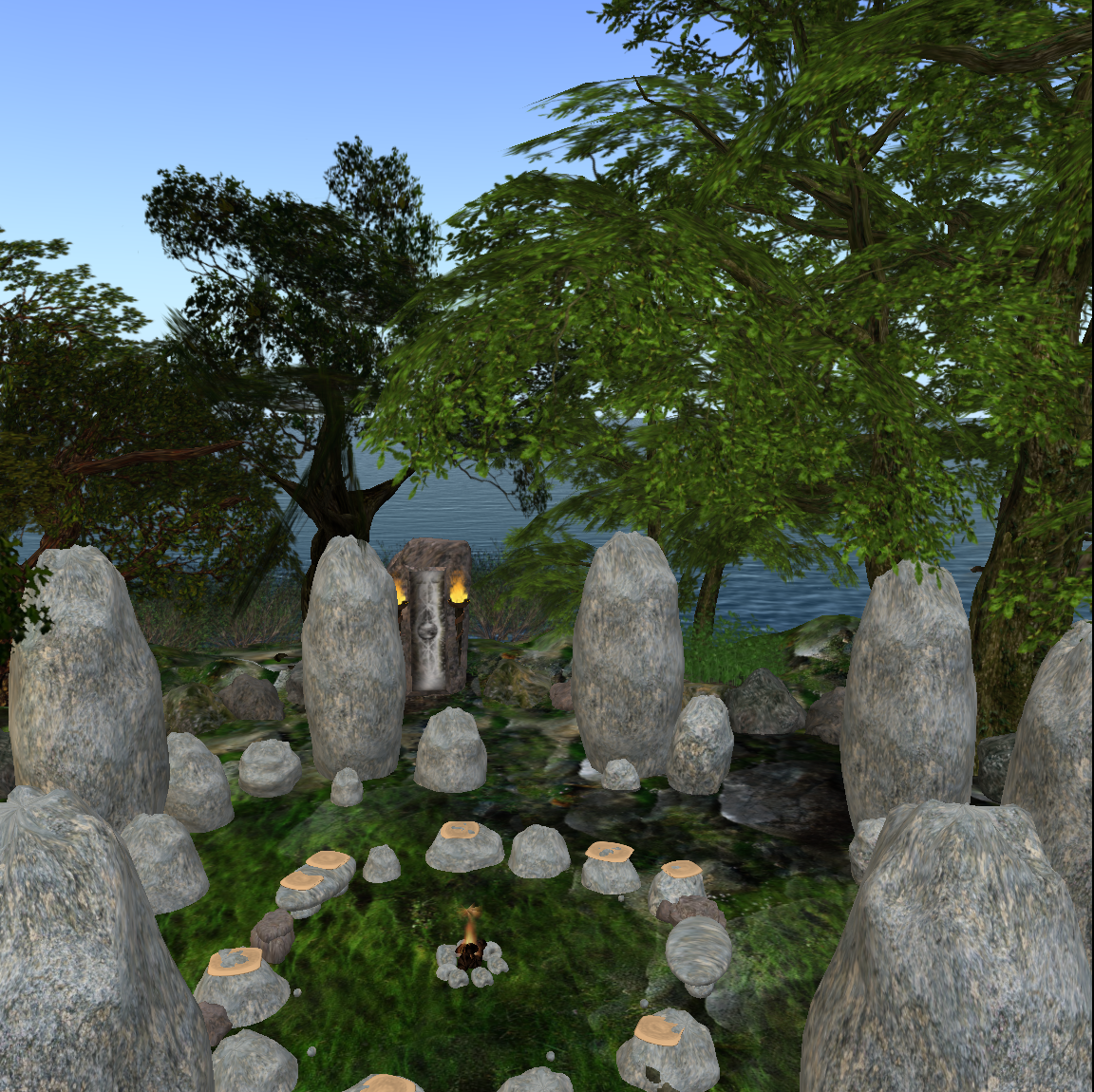
SOMA began as one small building on a small parcel, and grew rapidly without much planning. When they finally took over the entire sim, they asked me to come and help them expand in a more thoughtful way. I retained their original Asian building and helped them expand into a large Roman area and a Celtic-themed area featuring a stone circle.
SOMA now has a blog, “Ambrosia” and can be found on Twitter @SomaSecondLife. Inworld, join the group Bondage Soma to receive notices. Below is a quick photo tour of SOMA.
One arrives at a central plaza that leads to all the various venues. Yes, that is an Egyptian god in front of a Roman villa. That type of convergence is typical of SOMA.

The group enjoys weekly dances in The Pleasure Dome. Love the Alchemy Immortalis “Haute Suite” chairs.

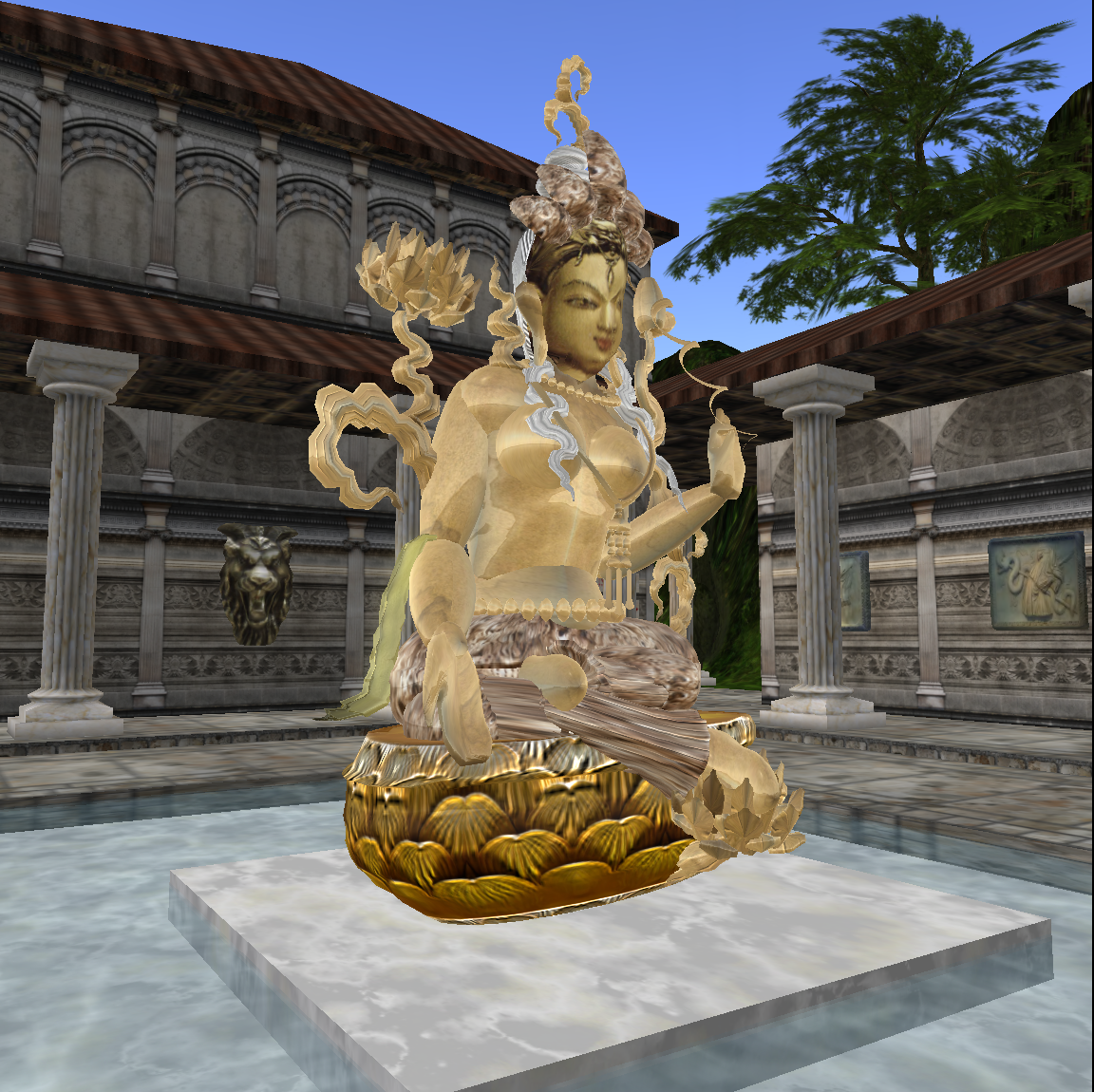
Sculpted deities by the amazing Ryusho Ort are featured in the central plaza.
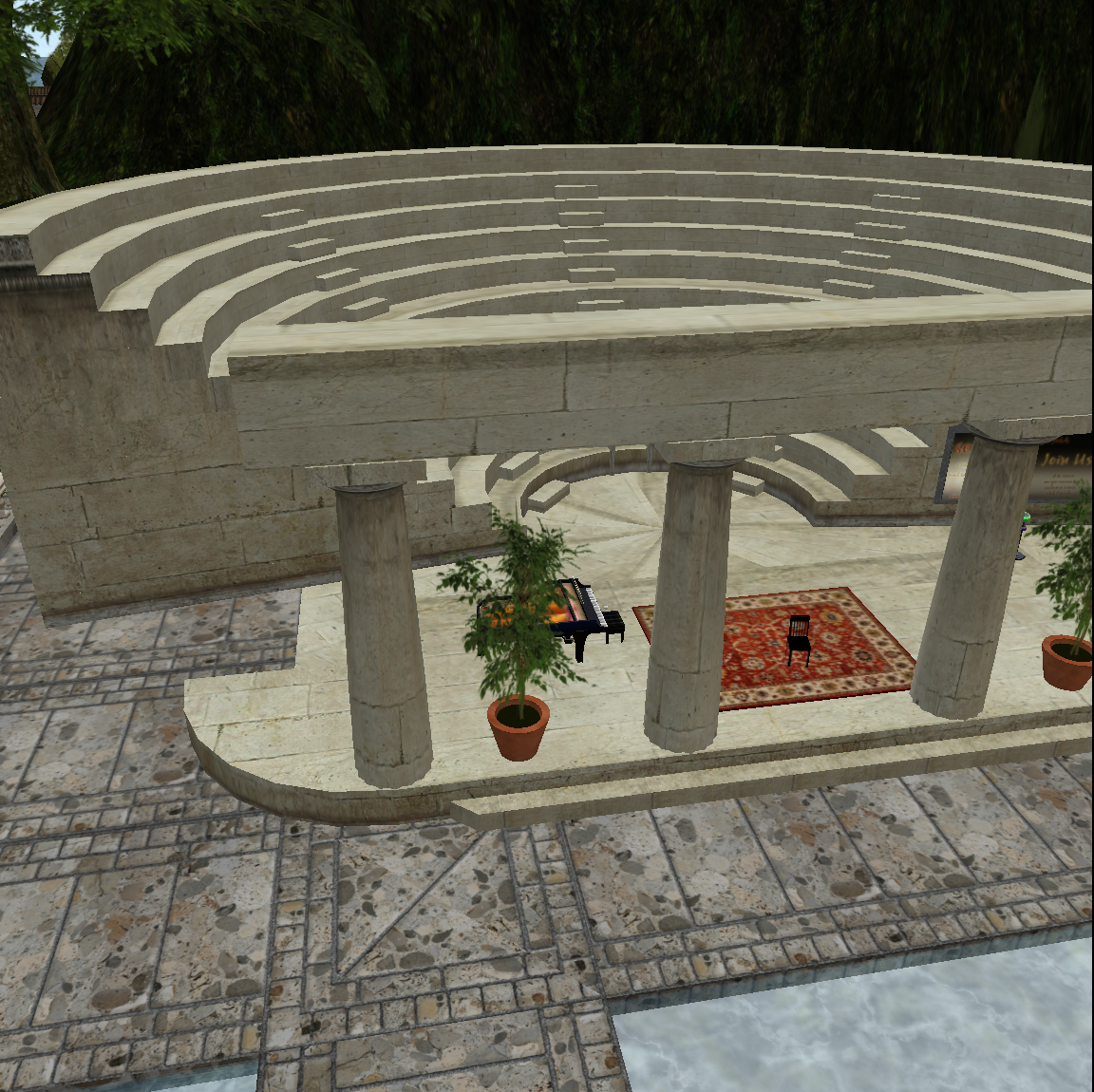
Prometheus Theater overlooks the plaza and is a setting for concerts and dramatic productions.
Villa de L’Arte is currently showing the work of the fabulous Bachi Cheng, a successful RL artist whose vibrant, colorful images celebrate life and love.

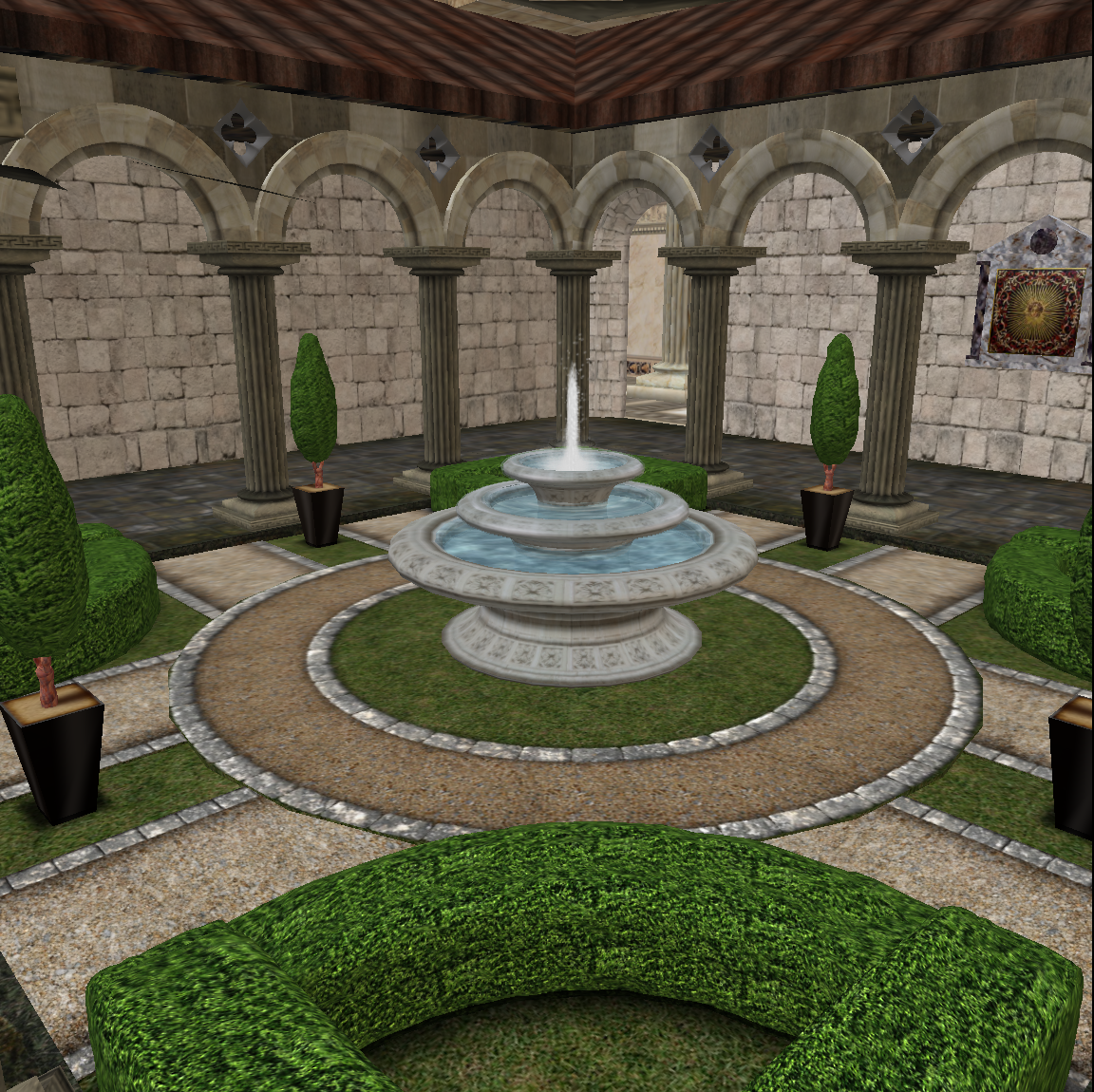
A small Roman peristyle garden offers a bit of serenity in a quiet cloister.
Artwork and logo by my wonderful friends Stephen Venkman and Seren Dawes.

Bacchus Pub, furnished with Max Graf’s excellent Rustica pub set.

The villa has several nooks and terraces for intimacy and romance.

Flute Alonzo’s furnishings have gorgeous textures and top quality animations.

One private room has a Gorean dance pit and a setting for small group gatherings.

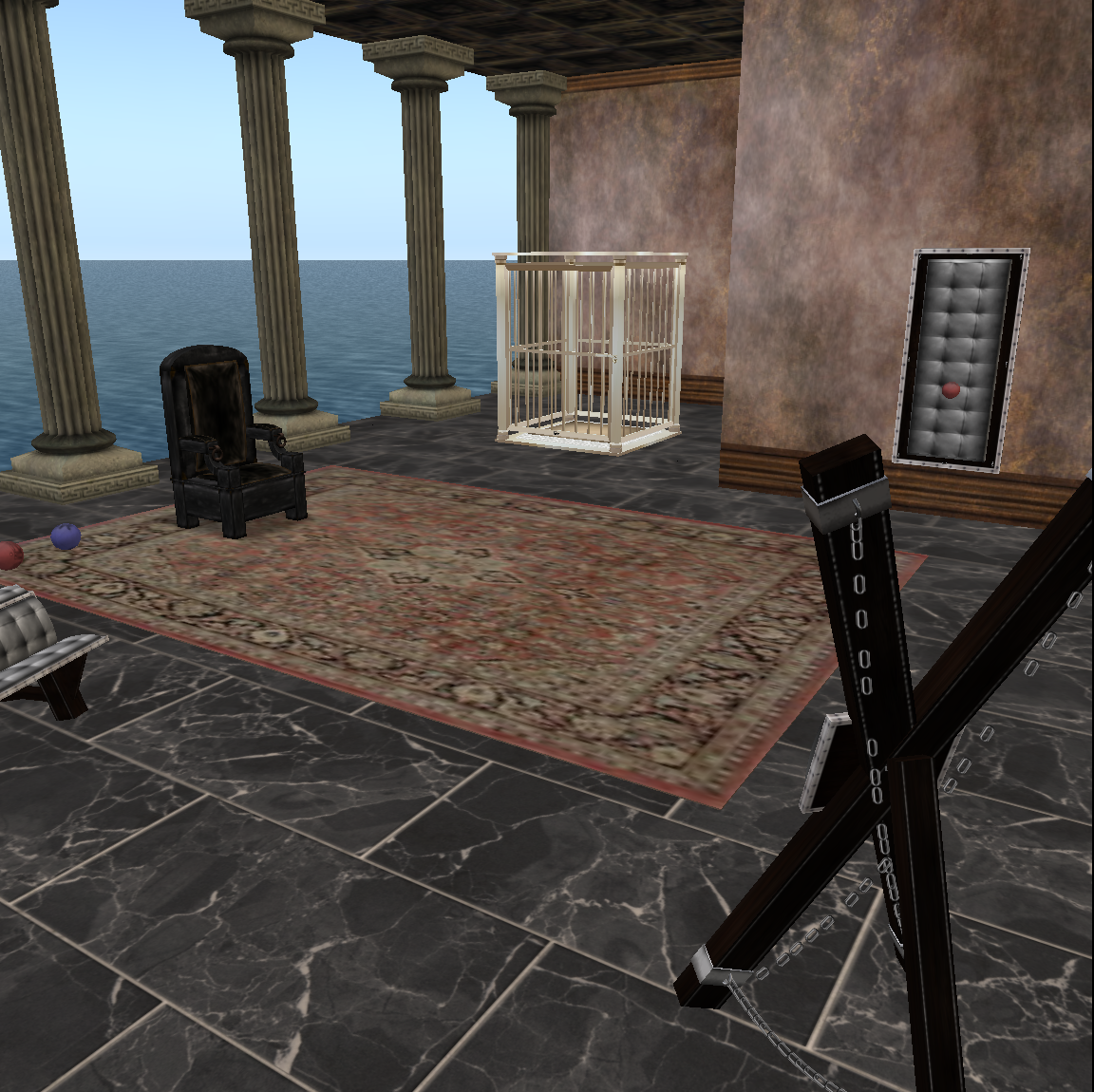
The sim is named Bondage. That said, it is not primarily a BDSM sim. But there is a small, elegant, intimate dungeon, the Temple of Bondage, well-equipped for sensual bondage play.

The Temple of Bondage has a lovely public room and three private rooms equipped with dozens of the finest BDSM toys from BFE, Deviant, Dictatorshop and Nihil.
The Temple of Zeus and Hera provides a setting for pagan rituals and… well, other things.

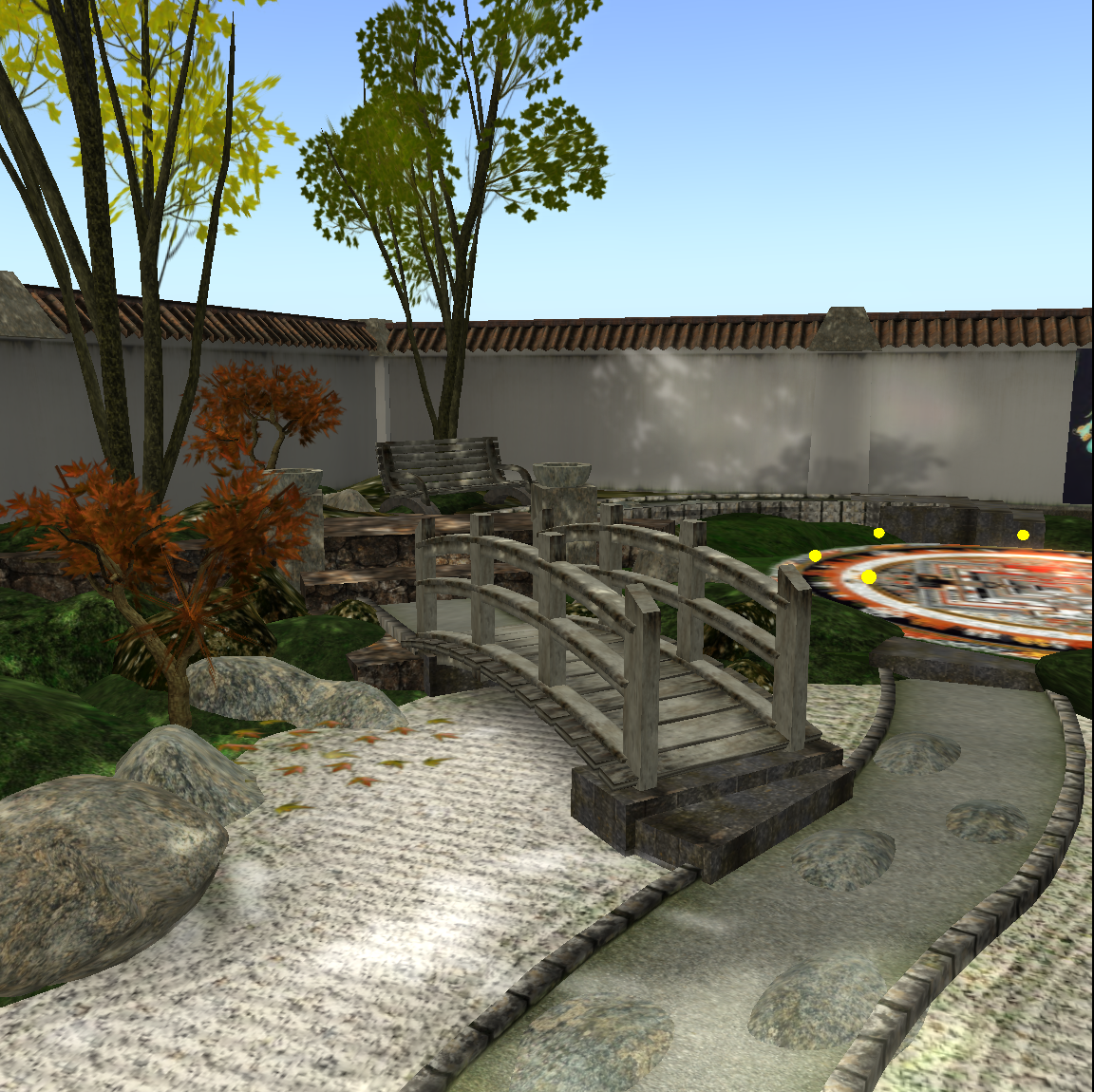
The Serene Meditation Garden is a lovely place for Tai Chi or just sitting, when you need to breathe.
This Stone Circle is the setting for a popular weekly discussion group. I landscaped the oak grove around the group’s slightly kludgy standing stones to which they have grown sentimentally attached.
Other features not pictured here include an elaborate undersea mer garden, tree house, beach house, and Japanese pleasure palace.
Be sure to stop by SOMA on Bondage and partake of its many pleasures.
 I keep meaning to post about this project that I did last summer in Second Life. Here it is finally.
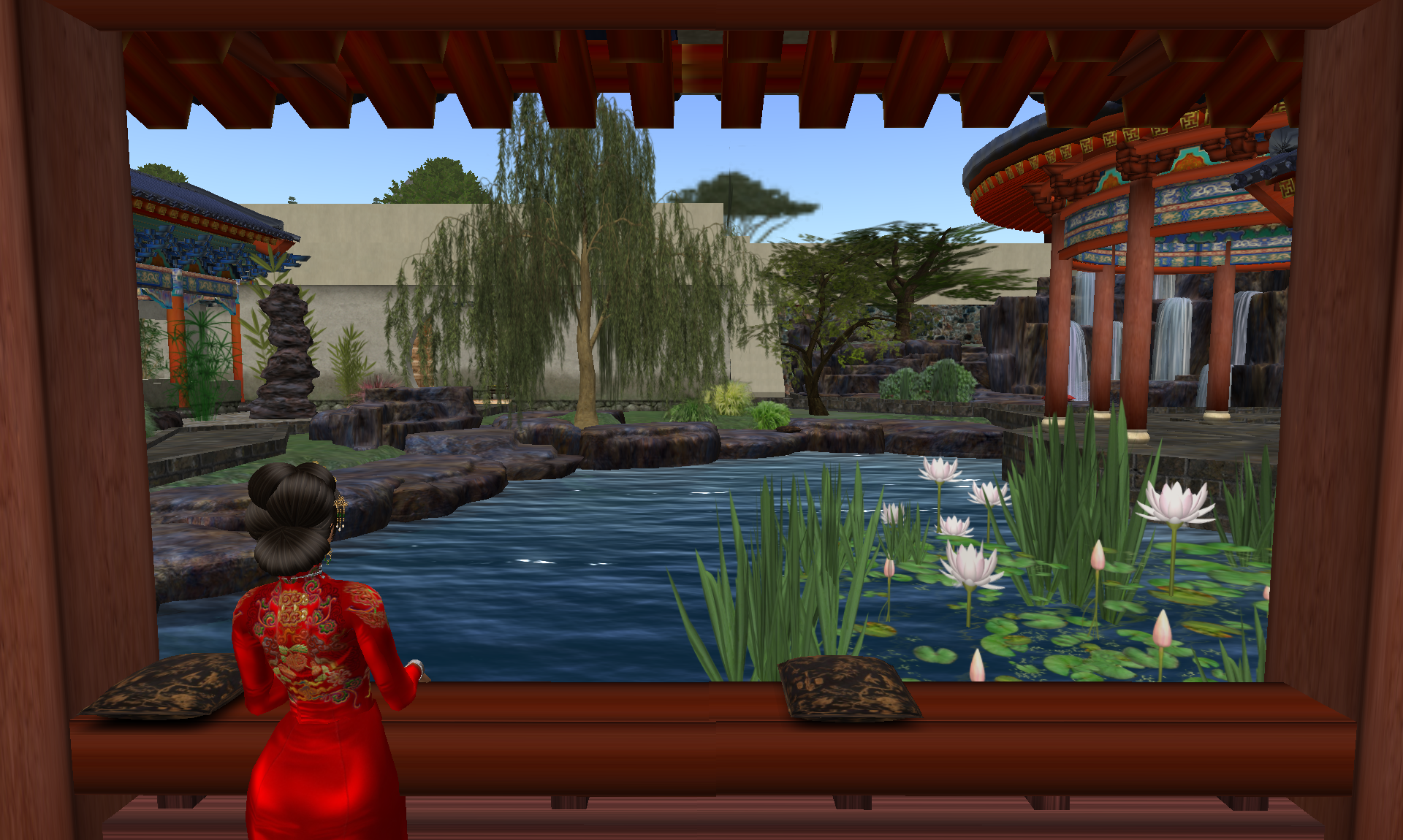
My friend Grath Helgerud asked me to build a Chinese Scholar’s Garden for him in Second Life, after seeing an exhibit about these intriguing gardens at the Metropolitan Museum of Art. Without knowing anything at all about what that meant, I accepted the challenge. As I began to research the style, I uncovered a vast new universe of thought that drew me in more deeply as I worked. This is not Chinoiserie — European impressions of China — this is authentic China, a world that fascinates me by being so “other”.
Chinese Scholar’s Gardens are an art form that flourished in China from the 10th-18th centuries. Creating one of these gardens was a favored leisure pursuit of the scholar class, a way to create a spiritual retreat from the pressures of professional life. Complex design principles produced a spiritual retreat within interior courtyards of the scholar’s home. Waterways are surrounded by carefully arranged rock gardens, trees and plants that all have poetic meaning, forming meticulously composed vistas. Pathways lead one on a journey, drawing you into it more and more deeply, offering interesting views and perspectives at each turn, framed by pavilions, halls, gates and windows.
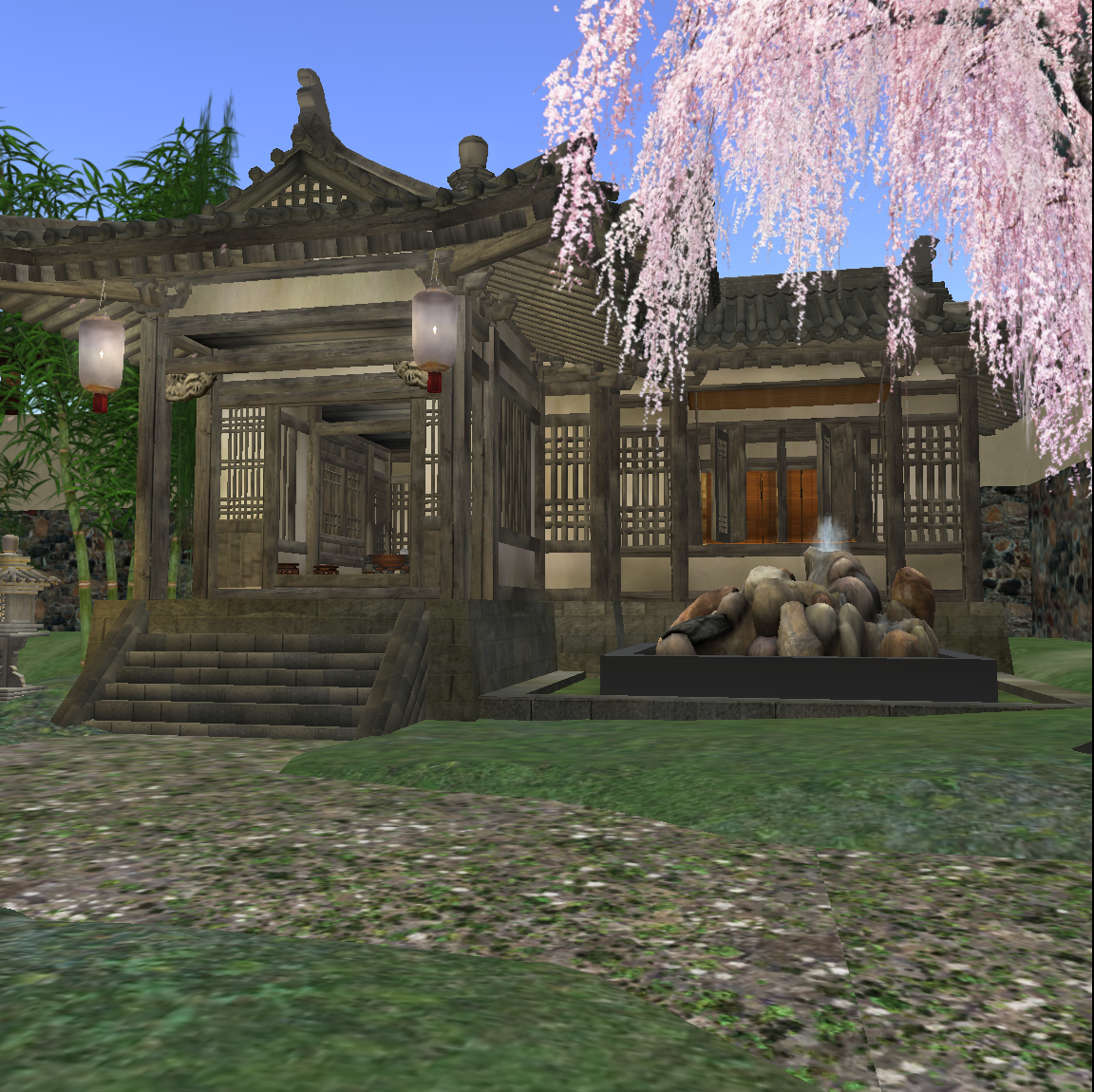 This was a challenging project because it required me to think in a completely different way. In the Western world we are more accustomed to a house surrounded by a park-like garden; this is a garden surrounded by a house. Architecture and sculpture are important elements; a Chinese garden is “built” as an abstraction and stylization of nature. It wouldn’t do to simply scatter some nice plants and trees around. Mathematical proportions must be precise; plants, rocks and structures have specific meanings and must be selected and placed just so. The end result is an immersion experience that takes you on a journey. Following the asymmetrical garden path, you encounter a variety of spatial connections as you pass from one section to another, being presented with new and pleasing views at every turn.
Everything in the garden has significance; there is meaning attached to every plant, every rock, every shape. It was more than simply a calm place for painting, poetry, calligraphy, study and music. To build a garden, a scholar had to understand fengshui, botany, hydraulics, philosophy, history, literature, poetry and architecture. The garden was considered a measure of his knowledge as well as a showcase of his aesthetic taste.
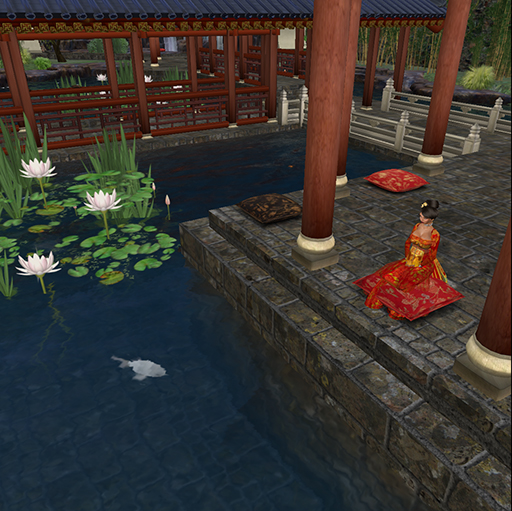 I had no such knowledge, of course. I was very fortunate to discover the work of the fabulously talented Ryusho Ort, who immediately impressed me with the beauty, technical virtuosity and authenticity of his Chinese buildings. We started with his Dragon and Phoenix Hall in the Ming dynasty style, and added others in Song and Tang dynasty styles. Ryu coached me along the way, and helped us create a very pleasing retreat.
Even the plantings were a challenge, since the design requires very specific types of plants and trees, not all of which are readily available in Second Life. It took quite awhile to find good quality flowering plum trees, peonies, and grasses. Bamboo, banana and lotus were a little easier, but I never did find the right type of orchid, or the quintessential Taihu rocks.
I was happy, though, to be able to find an excellent family of Mandarin Ducks and multicolored Koi to grace the ponds.
Naturally, spending time in the Chinese Garden required the proper attire! I am pictured here wearing Nicky Ree’s magnificent Phoenix Gown.
You can see the entire set of 16 photos on my Flickr page.
To learn more about Chinese Scholar’s Gardens, I recommend the Wikipedia page as well as this video as a good starting place. The Missouri Botanical Garden has another nice introduction on their website. On the Asian Historical Architecture website you can take in-depth photo tours of some of the famous gardens of Suzhou, China such as the Humble Administrator’s Garden, Mountain Villa with Embracing Beauty, and the Master-of-Nets Garden.
Click here to visit this Chinese Scholar’s Garden in Second Life. Grath has since added a few non-Chinese items, but there are still plenty of places to sit and relax, cuddle or slow dance. It’s a great place to visit for contemplation, meditation or relaxation — just like the originals were.
Recently I’ve been reflecting on past relationships I have had in virtual worlds. One of the things swirling around in my brain is the subject of honesty. Honesty in relationships is an extremely complicated idea. I’m writing this journal entry mainly for my own sake, to help me get it sorted out in my head.
How many couples say to one another, “Let’s be completely honest”? And how many couples actually are completely honest with each other? Not many, I’m betting.
The truth is that everyone lies. People lie for lots of reasons—some of them good reasons. It would be a mistake to cast all lies in the same light. Some lies are harmless; others are hurtful. Most lies swim in the gray area in between.
Fantasy role-playing could technically be considered a lie. Those of us in virtual worlds adopt an appearance and sometimes a persona that may or may not resemble our “real” selves. We operate under a social contract in which we all agree to suspend our disbelief about this. Some people are better at it than others. Some people look straight past your avatar and only want to know the “real” you. Others easily accept the fantasy avatar you have created. Is fantasy dishonest? Or is it playful?
Beyond fantasy, virtual worlds are a hotbed of deceit. Lying is far too easy. We can cover up where we are, and what we are doing, and with whom. We hide our online status. Knowing that no one can see our location, we feel free to invent stories about where we are. “I’m talking with a friend.” “I’m shopping.” “I’m checking something out.” Or, for total privacy, we just create an alt, and do as we please without detection. I know of at least one person who has a partner, and also a sex alt the partner doesn’t know about. I expect there are thousands of others in exactly the same situation. It almost seems to be the norm in virtual worlds.
Personally, I sometimes lie to preserve my privacy. When writing online profiles I usually say that I live in NYC. I don’t. I live near NYC, and I do spend time there, but I don’t live there. I don’t really want strangers to know where I live. I think that is a fairly smart lie and I doubt many would disagree.
“Privacy lies” happen when someone is pressuring you to reveal something about yourself that is actually none of their business. The response “that’s none of your business” might be counter-productive—it might actually increase your interrogator’s curiosity. Telling them something else may call off their prying. Are “privacy lies” good or bad? Rather than focusing on the morality of the lie, it would be better to examine the thing you are lying about, and decide whether it is hurtful.
That leads me to the “I didn’t want to hurt your feelings” lie. Sometimes this type of lie is actually compassionate, or at least benign, like when he assures her that she doesn’t look fat in those pants. But most of the time it’s bogus. Let’s say he cheats on her, and lies to cover his tracks. She confronts him. He says “I didn’t tell you because I didn’t want to hurt your feelings.” That’s bogus. The lie is not the issue. Clearly he didn’t mind hurting her feelings, because he cheated on her. That is what hurt her. The lie is extra. Lying about it is the secondary issue that piles hurt onto hurt.
What if he’d had the courage to be honest with her long before? What if he’d had the courage to admit that he wasn’t feeling satisfied? That she wasn’t meeting his needs? That something had changed in their relationship, or in him? That type of honesty is extremely difficult. First it requires being honest with yourself. Most of us would rather placate ourselves with lies. “Things are basically fine.” “I do love her.” “I can control myself.” “I can live without it.” “I should be satisfied.” When we can’t even face the truth about ourselves, how can we hope to be honest with anyone else?
The idea of hurting someone we care about is extremely difficult for most of us. He may find it impossible to imagine saying to her, “I’m not satisfied. This relationship is not giving me what I need.” He pictures her ashen face, the hurt and disappointment he sees there, and he just can’t face it. He can’t bear the burden of having to hurt her with the truth. So he lies.
When there is a truth that would hurt our loved one if they knew about it, it’s natural to want to withhold it, or cover it up. The trouble is that this deception almost never works. Not facing a painful truth does not make the painful truth go away. It just sits there, eating away at the relationship and causing damage to both of you. For the sake of not hurting her, he decides to forego his happiness. Does he think she won’t sense that? Does he think that he won’t eventually be compelled toward something outside the relationship that does meet his needs? Does he think that won’t hurt her even more?
Others may feel differently, but speaking for myself, I would choose a painful truth over a comfortable lie every time. Hurt can be healed, but only when it’s faced. If you need something that you can’t get from me, let’s face that together. Give me some credit. If I love you, I want good things for you. I am not so selfish as to demand that you fake it, just so that I can pretend that everything is fine. I know that relationships are not black and white. I know you care about me, and that, at the same time, it’s also true that I cannot meet all your needs. So tell me the truth. Let’s face the next step.
At least, that’s how I’ve always preferred it.
What do you think?
In my last post I discussed new opportunities for Opensimulator builders to obtain high-quality textures and sculpts from SL artists who are willing to license their products for Opensimulator virtual worlds.
In this post, I’d like to applaud some of the cooperating artists. Below I have listed some of Second Life’s top creators of high-end textures and/or sculpts who offer “other grid” licenses. I encourage you to support these artists by buying their products, so that they will be encouraged to continue to support OpenSim builders and help us improve the quality of our life here.
Note that in some cases, their products are sold only in SL or on the SL Marketplace, so you would need a Second Life account to receive delivery of the product or to contact the artist. Even if you are not currently active in Second Life, you might consider keeping an account there just for this purpose. One of my friends thinks of it like this: he lives in the suburbs, and occasionally visits the big city for a shopping trip!
TOP QUALITY CREATORS OF TEXTURES AND SCULPTS WHO LICENSE FOR OTHER GRIDS
Please suggest any other premium content creators you’ve worked with who license for Opensimulator.
Studio Skye – Alex Bader. Alex has just started making his outstanding textures available for download from his website. No Second Life account needed. http://www.studio-skye.com
Primmersive Designworks / E&D Engineering – Eryn Republic, Texture Engineer. Excellent, hyper-realistic textures, emphasis on postmodern, dystopian, industrial. Custom design available. Contact them for licensing info. https://marketplace.secondlife.com/stores/21145 (Second Life account required to receive delivery)
TRU Textures Ltd. – LillyBeth Filth (Elizabeth Gallagher) Extensive selection of quality textures available for download from website. No Second Life account needed. http://www.texturesrus.net/
Anthonys Republic. High quality sculpts. Choose between one-time license covering all products, or pay as you go. https://marketplace.secondlife.com/stores/22444 (Second Life account required to receive delivery)
Twisted Thorn Textures – Nighty Goodspeed. Only a small selection available on Marketplace; see SL in-world store for much more. Choose between one-time other-grid license covering all products, or pay as you go. https://marketplace.secondlife.com/stores/5019 (Second Life account required to receive delivery)
Door and Texture Store – VonGklugelstein Alter. Really useful materials for creating buildings. Contact VonGklugelstein Alter in SL for licensing info. https://marketplace.secondlife.com/stores/21912 (Second Life account required to receive delivery)
Panther 3D – Adaarye Shikami. Some textures available in SL at Twisted Thorn. Contact Adaarye Shikami for licensing info. https://marketplace.secondlife.com/stores/9149 (Second Life account required to receive delivery)
Jubjubs Stuff – Jubjub Forder. Several highly useful sculpts. Contact Jubjub Forder for licensing info. https://marketplace.secondlife.com/stores/15290 (Second Life account required to receive delivery)
Svo Michalak. Very nice sculpts of useful landscaping, food, tools and assorted other objects. He told me once that other-grid licensing is assumed for all his products however I would suggest that you contact him yourself to make sure. https://marketplace.secondlife.com/stores/18128 (Second Life account required to receive delivery)
FUD – Happyholly Grigges. Some good trees and other items. Contact Happyholly Grigges for licensing info. https://marketplace.secondlife.com/stores/8976 (Second Life account required to receive delivery)
CFD Cloud Factory Designs – Areku Shirakawa. Furniture sculpts. Contact Areku Shirakawa for licensing info. https://marketplace.secondlife.com/stores/15366 (Second Life account required to receive delivery)
FLECHA – Flecha Warwillow. Contact Flecha Warwillow for licensing info. https://marketplace.secondlife.com/stores/52128 (Second Life account required to receive delivery)
S.Town Sculpties – CrashOV Uladstron. Contact CrashOV Uladstron for licensing info. https://marketplace.secondlife.com/stores/39126 (Second Life account required to receive delivery)
Please suggest any other premium content creators you’ve worked with who license for Opensimulator.
The fact that everything is free in many Opensimulator grids may feel like a refreshing change for those who came from Second Life, where capitalism reigns. No money! No economy! Content creators freely share what they make. Take everything you want – it’s free!
On the other hand, it also presents a challenge for builders, especially those for whom quality is important. Most suppliers of high-end building materials in Second Life – textures and sculpts especially – are professional graphic artists who make a living at content creation. Not many of them are willing to provide materials for use in Opensim. They are, understandably, reluctant to give their livelihood away in a grid where they can’t easily be reimbursed. Without their supplies, quality materials are not plentiful.
Thus, Opensim builders typically have been faced with difficult choices. We can try to rely on whatever freebies are available here, which can be hit or miss. A few builders, sadly, simply steal materials. Others do their best to learn to make their own original textures, sculpts, scripts and animations, and while that’s probably the best solution, the learning curve can be extremely overwhelming.
However, there is another option. As OpenSim based grids like OSgrid grow in popularity, more and more creators of high-end building materials are willing to license their textures and sculpts for use on other grids, not just the commercial grids like Second Life, Avination or Inworldz. If you want the best quality, and if you are willing to pay a few pennies for it, you now have a lot more options.
We would like to thank these pioneering content creators for their willingness to support OSgrid builders. In my next post, I list their names and URLs. I hope that all OSgrid builders who value quality will support their businesses, as they support us by enriching our world.
We want to encourage high-end content creators to continue providing great textures and sculpts for use in Opensimulator. Support goes both ways. If we expect them to support us, we must be willing to return the favor – by buying their products, and also by treating them with respect:
If you don’t respect licensing agreements, you are only hurting yourself. Every time you use a texture or sculpt without permission, you make it less likely that high-quality textures and sculpts will continue to be available for to Opensim. Maybe you don’t want them; but when you don’t respect licensing agreements, you help to close off the supply to other builders who do want them. So please respect your fellow builders as well as the content creators whose work enriches our virtual world.
Virtual worlds have opened a door to BDSM for many people, allowing them to explore their curiosity about it in a fantasy environment. People who would never do so in “real” life can try on handcuffs, be chained and bound, and even submit to a Dominant, all without the risk of physical injury or social stigma. The wild popularity of BDSM in virtual worlds like Second Life and OpenSim attests to its genuine appeal in the sexual imagination.
But while casual dabbling in BDSM is safe and easy in virtual worlds, this very ease can be problematic. Those who have only experienced Domination and submission (D/s) in virtual worlds often think their experience and comprehension is complete. To be fair, I think some do develop a deep understanding; and the experience can be legitimate and worthwhile even for those who only get a glimpse of their own hidden desires, without fully exploring them.
Sadly, while virtual BDSM may be physically safe, I have seen far too many inhabitants of virtual worlds cause real-world emotional damage because they have no real idea what D/s is, or what it requires of them. It’s true that there is no one “right way” to do D/s. My Master and I practice an all-or-nothing form of D/s called TPE (Total Power Exchange), but even casual dabbling in D/s is not intrinsically wrong when it brings pleasure to all those involved. Unfortunately, too often it does not.
I’m not going to discuss the abusive sexual predators that lure women by claiming to be “Masters,” and then take advantage of them while ignoring a Dominant’s responsibilities. Much has been written of this elsewhere. In my case, I am fortunate to have a genuine Master who knows what he is doing, a good and loving man who takes his responsibilities seriously and who has the training, good character, compassion and strength to be a skilled Dominant.
Instead, I’d like to reflect on women I have met who call themselves submissives, but who are only posing. Bogus submissives have only their own self-interest in mind; they manipulate others and take advantage of them for their own agenda. They cause just as much emotional damage as bogus Masters. They are a special breed of sexual predator.
The dabblers who call themselves submissives usually have no idea what submission involves.
If you enjoy being restrained during sex… you are not necessarily submissive.
If you are attracted to a strong-willed man… you are not necessarily submissive.
If you wear a collar and know how to nadu… you are not necessarily submissive.
If you always do what everyone tells you to do… you are not necessarily submissive.
If you cooperate with a Master because you have no choice… you are not necessarily a submissive.
If you allow a Master to do only what you want him to do… you probably are not submissive.
If you tell a Master only what you think will get you laid… you probably are not submissive.
If you think you could roleplay as submissive sometimes… you probably are not submissive.
What are the differences between a bogus submissive and a genuine one? To me, the difference is a matter of character and nature. Some people play a submissive role. But some of us find that submission reveals our truest selves, our deepest, most authentic nature. Submission isn’t about what we do. Submission is about who we are.
Does the idea of surrendering complete control of yourself to a trusted Master thrill you? Does the excitement increase the more you surrender? Are you turned on by the thought of permanently abandoning your will to his? If so, then you probably are a submissive.
On the other hand, if it fills you with dread and suspicion, you probably are not a submissive.
The acid test comes the first time the Master directs you to do something you really don’t want to do. Many women are willing to play a submissive role temporarily—as long as she trusts that the Master will do exactly what she wants him to do to please her. There is nothing wrong with that. But it isn’t submission, it’s just cooperation. True submission is complete surrender. Of course you want pleasure, and a good Master wants that for you. But TPE submission means completely letting go of your own will, and trusting him, without setting your own pleasure as a condition. For a true submissive, that very act of surrender is the pleasure—that intoxicating rush of letting go and giving yourself to him.
You may think it sounds passive and easy to surrender your will. Power exchange is far from easy. It is a conscious choice you must make, over and over again, that requires a great deal of courage and inner strength. Saying yes to him means that you must be strong enough to say no to everyone else, including yourself. True submission means having true power, and then giving it away. You must own your own power, before you can give it away.
You may be able to deceive him, to play along and make him think you are surrendering, while in reality you hold on to your own power. That’s why I mentioned character. You know if you are not being honest. And eventually it will come out. If you are willing to lie to your Master, that is a matter of character. If you know you aren’t a true submissive, if you basically just want him to be your lover on your own terms, and yet you play the part of a true submissive—you are living a lie. You may in fact be a sexual predator. You risk causing emotional damage, whether you mean to or not.
If my description of total submission doesn’t appeal to you, there is no fault in it. It’s not a bad thing to admit that you like to role play as a submissive occasionally, but that you are not really cut out to be an authentic, 24/7 TPE submissive. I encourage you to enjoy dabbling in BDSM, and to take and give pleasure where you can.
But if you know this about yourself, do not try to hide it. If you are not a true submissive, do not try to pass yourself off as one.
In recent months, I have watched more than one bogus submissive wreak havoc in the lives of people I love. With only her own pleasure in mind, she accepted a collar and the loving care and protection of a Master. Thinking only of what was in it for her, she mouthed the words “yes Master” without revealing what she was thinking: “…as long as it’s convenient for me.”
She didn’t want a Master; she just wanted a lover.
She did whatever it took to lure him into a relationship under false pretenses.
She played the role, like a game, taking what she could get.
She let him love her, as long as it was convenient.
And when it came time to live up to her promise, she deserted him and broke his heart.
She damaged us, too. The betrayals cut like a knife through the community of family and friends who supported our beloved Master and friend. We agonized with him, hurt for him, dropped everything to stand by him when he needed us. We, too, suffered, as his open and generous spirit shuttered tight, his trust broken.
But the bogus submissive never stopped to think of what her lie would do to us, or even to him. She never considered the pain she caused. She thought only of herself.
She left in a whirlwind of drama that she created, a smokescreen with which she attempted to veil her deception. She did not have the strength of character to say, “I’m sorry. I thought I was cut out for this, but I’m not.” Instead, she invented some bogus reason to make it seem that she was not at fault. But she fooled no one, except perhaps herself.
I have seen this scenario play out more than once in recent months. My motivation in writing this post is not to claim “I’m a true submissive and you’re not.” It is, rather, a cry of resentment that the dishonesty of bogus submissives hurts me and my loved ones.
I decided to try Victorian…! We wanted to make our new shopping area reminiscent of New Hope, PA and other small towns where the original Victorian houses have been converted to funky, eclectic shops. I made most of them fairly simple, but on this one, I got inspired to go full tilt. As they say, if you stood still for 5 minutes, the Victorians would try to decorate you… so the last thing a Victorian house should be is simple!

It’s loaded with highly detailed authentic features, including a wraparound porch, turret tower, sculpted balustrades and spandrels, fretwork, decorative shingles and “Stick” detail. The interior was painstakingly textured to match the Victorian styling. The double hung windows even work!
I took my inspiration from various Queen Anne style houses in New England, and the famous “Painted Ladies” of San Francisco. I had a lot of fun researching the style, and planning the materials.
This is one of those “only in OpenSim” builds at 985 prims (no problem, we’ve got plenty more). A residential version will be forthcoming soon, with authentically styled interior. I might try to do a somewhat less primmy version for SL.
The store is offered rent-free. Land ownership is included, also free. We want to encourage content creators to share their creations with our residents by offering them free space to do it. If you’d like to move in, contact Walter Balazic or Camryn Darkstone inworld in OSgrid.
Come see it on the Littlefield NE sim in OSgrid.
See more of Littlefield at our Flickr page.
 the space between